
“During” the Dispute: Key Principles Developed in Domain Name Case Law
The Uniform Domain Name Dispute Resolution Policy (“UDRP” or “Policy”) has generated more than two decades of case law. While the text of the Policy itself has remained largely unchanged since 1999, the interpretation of its provisions has evolved significantly through panel decisions. While the UDRP does not operate on a strict doctrine of precedent-based approach [1], in practice, it is a quasi-jurisprudence-driven system, where panels rely on earlier decisions for several matters in order to ensure consistency and predictability in the outcome.
Several core principles applied in domain name disputes today have emerged from landmark decisions and the succeeding accumulation of panels referencing those decisions and applying the underlying principles. These principles shape interpretative details and thresholds of a dispute, specifically vis-à-vis the evaluation of the three elements of the Policy: (i) confusing similarity, (ii) legitimate interest, and (iii) bad faith.
In its Final Report on Internet Domain Name Process in 1999, the World Intellectual Property Organization (“WIPO”) stated that “It is to be hoped, however, that with experience and time, confidence will be built up in the credibility and consistency of decisions made under the procedure, so that the parties would resort less and less to litigation. The decisions taken under the procedure would be made available publicly.”[2] In light of this, and in order to form consistent approaches to recurring issues, WIPO and later other domain name dispute resolution providers created an overview of principles and case law. WIPO’s Original Edition of its Overview of WIPO Panel Views on Selected UDRP Questions (“WIPO Overview, Original Edition) [https://www.wipo.int/amc/en/domains/search/oldoverview/] was released in 2005, and Version 2.0 in 2011. Its third edition was recently updated to the “WIPO Overview 3.1” [https://www.wipo.int/amc/en/domains/search/overview], which was released in February 2026.
Another example of such selection of UDRP-related case law is the Overview of Czech Arbitration Court Panel Views on Selected Questions of the Alternative Dispute Resolution for .EU Domain Name Disputes, 2nd Edition (“CAC .EU Overview 2.0”) [https://eu.adr.eu/website/cac-eu-overview-20], which concerns only the .eu ccTLD.
In this blog post, we will explore key principles developed by UDRP panels across the three substantive elements of the UDRP.
I. First UDRP element
1. Top-Level-Domain and Relevance for Identity or Confusing Similarity
As mentioned in an earlier post, the first element of the UDRP requires the complainant to show that the disputed domain name is identical or confusingly similar to a trademark in which it has rights.
A central concept developed through case law is the practice of disregarding the top-level domain name (“TLD”) in determining identity or confusing similarity between the disputed domain name and the complainant’s rights. This practice applies to all TLDs, including new generic top-level domains(“gTLDs”) and expresses a unanimous view of the panels. It seems that this issue has been mentioned only in the second edition of the WIPO Overview (published in 2011, Question 1.2), but dates back to the Zuccarini[3] decision in 2000 regarding <guinnes.com>, where the Panel stated that “[t]he addition of the generic top-level-domain (gTLD) .com is without legal significance in determining similarity”.
Even though the identity as well as the confusing similarity tests had already been conducted by comparing the disputed domain name, such as <trademark.tld>, with the complainant’s trademark and disregarding the top-level domain name, the panels had not explicitly mentioned the latter in their reasoning.
The Zuccarini case followed others, such as the Arthur Guinness case[4] where the Panel stated that “[e]xcept for the missing "N" in the domain name and the inconsequential suffix ".com", the two are identical”, the Bentley Motors case[5], where the Panel confirmed that “[a]s to whether the Disputed Domain Name is identical or confusingly similar to the BENTLEY Mark, the relevant comparison to be made is with the second-level portion of the domain name only (i.e., “bentleymotorcars”), as it is well-established that the top-level domain name “.com” may be disregarded for this purpose.” or the SAP case[6] where it becomes clear that “[t]he disputed domain name is identical to the Complainant’s trademark but for the generic Top-Level Domain (“gTLD”) “.app” which is typically to be disregarded for the purposes of comparison.”.
As the above has been the consensus view, there is one exception to the rule, namely in cases where the applicable TLD and the second-level portion of the domain name in combination contain the relevant trademark[7]. Panels may then consider the domain name in its entirety for purposes of assessing confusing similarity (e.g., the disputed domain name is <trade.mark>)[8]. Examples of such domain names are <tes.co> in WIPO Case No. DCO2013-0017 (Tesco Stores Limited v. Mat Feakins), <b.mw> in WIPO Case No. DMW2015-0001 (Bayerische Motoren Werke AG v. Masakazu/Living By Blue Co., Ltd.) or <swarov.ski> in WIPO Case No. D2016-2036 (Swarovski Aktiengesellschaft v. Aprensa UG haftungsbeschraenkt, Mike Koefer).
2. Typosquatting
As explained earlier, typosquatting is the practice of misspelling a trademark. According to the WIPO Overview 3.1, Question 1.9, typosquatting has been specified as when a domain name consists of a variation of a trademark, typically a common, obvious, or intentional misspelling of a trademark.
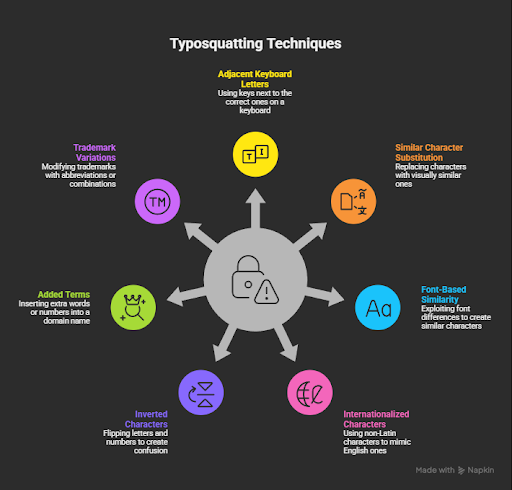
Examples of such variations include: (i) adjacent keyboard letters; (ii) substitution of similar appearing characters (e.g., upper vs lower case letters or numbers used to look like letters); (iii) the use of different letters that appear similar in different fonts; (iv) the use of non-Latin internationalized or accented characters; (v) the inversion of letters and numbers, or (vi) the addition or interspersion of other terms or numbers; or (vii) other variations of the trademark (e.g., abbreviations or combinations of select elements of the mark).
The variations of a trademark can certainly be of relevance to the first UDRP element, but is also important for the second and third element, since the fact that the domain name contains sufficiently recognizable aspects of the relevant trademark, panels will normally find that employing a misspelling of a trademark way signals an intention on the part of the respondent to confuse internet users seeking or expecting the complainant.[9]
Typical examples of typosquatting cases are the following:
a) <twıtter.com>[10]
In this case, the Panel found that the disputed domain name was a misspelt version of the Complainant’s trademark. More specifically, that the disputed domain name “which displays as the term “twitter” but using the Turkish dotless character “ı”, is phonetically and visually similar to Complainant’s TWITTER trademark.”.
Such a minor alteration was considered a classic case of typosquatting, i.e. intentionally creating a domain name that relies on users’ typing errors. The Panel held that this kind of misspelling does not prevent confusing similarity with the trademark.
b) <facenook.top>, <faceook.top>, <facrbook.top> et al.[11]
In this case, the Panel confirmed that the Complainant (Meta/Facebook) holds well-established trademark rights. Each disputed domain name incorporated a version of the FACEBOOK mark, despite minor alterations. The Panel explicitly characterized the domain names as “common, obvious, or intentional misspelling[s]” of the trademark. Those included letter substitutions, omissions, or adjacent-keyerrors (e.g. “facenook”, “faceook”, “fcebook”).
c) <coparrt.com>[12]
This case relates to a common law trademark (also known as an unregistered trademark) where the Complainant succeeded in convincing the Panel of the existence of the trademark and the Complainant’s rights in it. Regarding typosquatting, the Panel concluded that “[t]he disputed domain name is composed of an element "coparrt" in combination with the gTLD <.com>. The COPART mark is reproduced within the disputed domain name. The only difference between the disputed domain name and Complainant's mark is the inclusion of an additional letter "r".”
3. Trademarks with design elements
Something that the UDRP is clear about is that the standing criterion for filing a complaint is, first and foremost, to prove rights in “a trademark or service mark”. As we have covered what a service or common law mark is, and that both a trademark or a service mark will be subjected to a test on identity or confusing similarity against the disputed domain name, the topic of design trademarks (trademarks with design elements) has not been discussed yet.
The Policy does not explicitly answer that question; however, we know that when panels assess the identity or confusing similarity, this assessment involves the (alphanumeric) domain name and the textual components of the relevant mark.[13]
In light of the above, the first question is whether a design trademark satisfies the eligibility requirement of demonstrating rights in a mark. While trademarks incorporating design elements may be more difficult to assess—particularly where only the visual components are at issue—panels generally take a permissive approach at the standing stage and tend to find this requirement fulfilled, except in cases where the design element is dominant, and there is no evidence of such term or information in the disputed domain name. When assessing confusing similarity, panels typically place greater emphasis on the verbal (non-design) elements of the trademark.[14]
a) <hero.com>[15]
In the WIPO case <hero.com>, the Complainant “provided substantial evidence of having long-standing rights in registered marks that incorporate the textual element HERO. The disputed domain name is plainly identical to that element.”
However, the Respondent claimed that the word “hero” is a commonly used word, and because Complainant’s mark is a “stylized mark” which did not only protect the word “hero” per se, the disputed domain name is not identical or confusingly similar.
The Respondent supported its submission with several cases, one of which the Panel discussed in particular. The Respondent referred to the Tesla Industries, Inc. v. Stu Grossman d/b/a SG Consulting[16], where the Panel clearly distinguished that in the Tesla case, the comparison was between a “highly stylized mark” and a domain name, whereas in the Hero case, that was not the case. Further, it stated that “[t]he Complainant's trademark for HERO is stylized to some extent, but not highly so.”
This case is a clear example of the importance of submitting relevant evidence and case law in support of each side’s arguments, as well as the level of design elements in a trademark, which are crucial for the case’s outcome.
b) <ethno.com>[17]
In the case of <ethno.com>, the Panel found that the Complainant demonstrated rights inter alia in a registered trademark in the Russian Federation, which comprised of a prominent propeller-like device element and the word mark ETHNO underneath it. Further, the Complainant did not have a plain word trademark registration for the word “ethno” and failed to provide any evidence of usage rights in “ethno” as an independent word mark. There, the Panel analysed the factual situation and started its assessment with respect to the first UDRP element.
The Panel confirmed the consensus view that “in assessing confusing similarity between a domain name and a trademark comprising a combination device and word mark” one should be making “a literal comparison of the trademark and the relevant domain name, considering the overall impression given by the mark, taking into account as appropriate the strength of the word mark element which is being directly compared with the domain name and considering the relevant prominence of the word mark element in the context of the overall impression given by the trademark.” However, in the instances where “the device element forms a particularly prominent part of the relevant trademark, and the word element is a common or dictionary term”, in those cases panels have found it appropriate for the complainant to have the onus “to present the panel with compelling evidence of secondary meaning and distinctiveness through extensive use”.
In this case, the Panel decided that the word “ethno” is “a Greek word that is commonly used as a prefix in the English language referring to the study and development of groups of people” and that the Complainant did not prove the acquisition of distinctiveness for that word in relation to the Complainant’s goods and services. In the Panel’s view “the word “ethno” is no more prominent than the propeller-like device element”, “the Complainant’s trademark is not even close to being a word mark registration for ETHNO or even a fancy stylized version of the word mark, and that the combined trademark evokes more than the word alone” and therefore it concluded that the disputed domain name is not confusingly similar to the Complainant’s trademark.
4. Trademark + third party trademark
Another interesting scenario is when a disputed domain name includes the complainant’s trademark in addition to other third-party marks, i.e. <mark1+mark2.tld>. According to the consensus view, having a third-party mark in combination with the recognizable mark of a complainant, in itself is insufficient to avoid a finding of confusing similarity.
In these complex cases, what is considered appropriate is evidence of the third-party mark holder’s consent to file the case, and request that any transfer order be issued in favor of the filing complainant only.[18] Absent such consent, some panels have ordered the transfer of the domain name without prejudice and in exceptional cases, some panels have ordered the cancellation of the disputed domain name.[19]
a) <viagra-nascar.com>[20]
In this case, the Complainant was Pfizer Inc., the pharmaceutical company owning the VIAGRA trademark. In addition, the disputed domain name incorporated the third-party trademark NASCAR. The Complainant submitted authorization from the holder of the NASCAR trademark “sufficient to relieve potential concern that transfer of the disputed domain name to Complainant would interfere with the rights of the third-party trademark holder”, and therefore the Panel ordered the transfer to the Complainant.
b) <pallmall-marlboro.com>[21]
In this case, the Panel considered in detail the facts and the circumstances in relation to the remedy of transferring the disputed domain name to one trademark holder of the two displayed trademarks in the disputed domain name.
In this case, no explicit consent was given to the Complainant by the third-party trademark holder. Therefore, the Panel considered all possible remedies carefully and decided that “there is no basis in principle or in practice for denying a complainant the remedy of transfer merely because the disputed domain name contains, in addition to the complainant’s trademark, a trademark owned by a third party.”and transferred the disputed domain name without prejudice to the Complainant.
II. Second UDRP element
1. Reversal of the burden of proof
UDRP proceedings generally involve a single round of pleadings and no discovery, meaning that panels decide cases based on the complaint, any response, and available evidence. While panels may draw inferences from a respondent’s failure to reply, they will assess all evidence on record.
While the overall burden of proof rests with the complainant, with respect to the second UDRP element, panels have recognized the difficulty of “proving a negative”, i.e. that the respondent lacks rights or legitimate interests in a domain name. Therefore, once the complainant establishes a prima facie case, the burden of production shifts to the respondent to demonstrate relevant rights or legitimate interests. If the respondent fails to do so, the complainant is deemed to have satisfied this element. One of the first decisions supporting this approach is the Julian Barnes[22] case, where in the Panel’s view “the correct approach is as follows: the Complainant makes the allegation and puts forward what he can in support (e.g. he has rights to the name, the Respondent has no rights to the name of which he is aware, he has not given any permission to the Respondent). Unless the allegation is manifestly misconceived, the Respondent has a case to answer and that is where paragraph 4(c) of the Policy comes in. If the Respondent then fails to demonstrate his rights or legitimate interests in respect of the Domain Name, the complaint succeeds under this head.”. This approach has been manifested ever since.
2. Free Speech and Criticism Sites: the “sucks cases”
Earlier posts analyzed case law and under what circumstances a respondent can support an argument of legitimate noncommercial or fair use of the disputed domain name. In this blog post, we will analyze a very particular part of those cases, namely the “sucks cases” (e.g. <[trademark]sucks.com> or <trademark.sucks>).
Those cases have also been relevant in the context of the first UDRP element, when assessing confusing similarity, with the result being that a domain name consisting of a trademark and a negative or pejorative term is considered confusingly similar to the complainant’s trademark.
With respect to the second UDRP element, the “sucks cases” have raised several questions when it comes to assessing the fair use of such domain names. Where the domain name is not identical to the complainant’s trademark, but it comprises the mark plus a derogatory term (e.g., <trademarksucks.tld>), panels tend to find that the respondent has a legitimate interest in using the trademark as part of the domain name of a genuine criticism site if such use is prima facie, genuinely fair, and not misleading or false.[23]
A very interesting decision is the <sermosucks.com>[24] decision, where even if the Respondent was in default, the Panel decided that the Complainant “failed to sustain its burden of proving that the Respondent lacks right or a legitimate interest in the Domain Name” and concluded that it did not believe that the Respondent’s website constituted, as Complainant argued, an “intent for commercial gain to misleadingly divert consumers” since the logo on Respondent’s website prominently read “sermo sucks” and “the website was clearly and obviously a site that was highly critical of Complainant.”
Further, “[b]ecause it was an obvious criticism site, and not a site deceptively designed to lure Internet users in on the false pretense of being the Complainant’s site” the Panel denied the Complainant.
In conclusion, the issue of free speech and criticism sites under the UDRP is a balancing act. Even though the UDRP was primarily designed to address cybersquatting, the use of a domain name may also engage broader considerations, particularly in cases of legitimate criticism sites with a valid free speech argument that justifies their existence.
III. Third UDRP element
Under paragraph 4(a)(iii) of the UDRP, the complainant must prove that the disputed domain name has been registered and is being used in bad faith. Paragraph 4(b) of the UDRP sets out a non-exhaustive list of circumstances that, if found by the panel to be present, shall be evidence of the registration and use of a domain name in bad faith.
Without going into detail, and even though there are numerous circumstances that have led to interesting case law, a core problematic has always been the “passive holding” of a disputed domain – especially, considering the complainant’s burden of proof for the “bad faith use” requirement of the disputed domain name by the respondent.
Since the early application of the UDRP, panels have consistently held that mere inactivity—such as a blank or “coming soon” page—does not preclude a finding of bad faith. Under the doctrine of passive holding, a domain name can still be considered registered and used in bad faith when assessed in light of the overall circumstances of the case.[25]
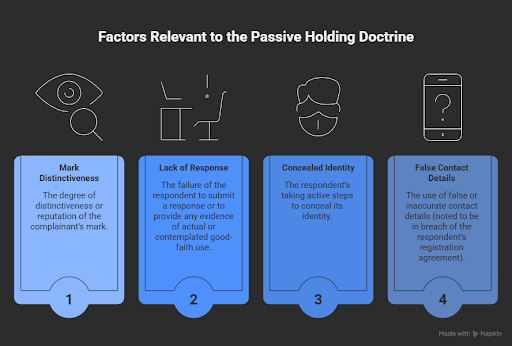
Factors that have been considered relevant in applying the passive holding doctrine include:
(i) The degree of distinctiveness or reputation of the complainant’s mark;
(ii) The failure of the respondent to submit a response or to provide any evidence of actual or contemplated good-faith use;
(iii) The respondent’s taking active steps to conceal its identity; or
(iv) The use of false or inaccurate contact details (noted to be in breach of the respondent’s registration agreement).[26]
The landmark decision in Telstra Corporation Limited v. Nuclear Marshmallows[27] established that even the non-use of a domain name—such as maintaining a blank or “coming soon” page—can, in appropriate circumstances, amount to bad faith. In the Telstra case, the Panel distinguishes between “undertaking a positive action in bad faith and acting in bad faith”, which it deems to be “an important one”. It further concludes that “[t]he significance of the distinction is that the concept of a domain name "being used in bad faith" is not limited to positive action; inaction is within the concept. That is to say, it is possible, in certain circumstances, for inactivity by the Respondent to amount to the domain name being used in bad faith.”.
Nevertheless, the decision also mentions that the “passive holding” should not be invoked only when there is no active use of the disputed domain name or in an abstract way; panels must always assess the particular facts of a specific case and “give close attention to all the circumstances of the Respondent’s behaviour”.[28]
After more than 25 years, the “passive holding” doctrine remains a cornerstone of UDRP practice, underscoring that doing nothing with a domain name does not necessarily equate to good faith.
___________________________
About the author:

Stefanie Efstathiou is a dual-qualified lawyer (Greece and Germany) specializing in Intellectual Property, AI, Data Protection and Alternative Dispute Resolution, with particular expertise in domain name disputes. She serves as in-house counsel at DENIC eG, the registry for .de domain names, and acts as a panelist for several domain name dispute resolution providers. Her academic and professional work lies at the intersection of technology and ADR, where she is also pursuing a PhD at the Ludwig Maximilian University (LMU) in Munich on AI and Arbitration. In addition to her academic engagement, she also contributes as a member of an international task force developing guidelines on the use of AI in Arbitration, and regularly engages in conferences, professional networks, and publications in this field.
———————————————————————————————————————————
Editors: Mihaela Maravela and Mihaela Apostol (ArbTech)
[1] WIPO Overview of WIPO Panel Views on Select UDRP Questions (“WIPO Overview 3.1”), Introduction, https://www.wipo.int/amc/en/domains/search/overview
[2] Final Report of the WIPO Internet Domain Name Process, The Management of Internet names and addresses: Intellectual Property Issues, para. 153, April 30, 1999, https://www.wipo.int/amc/en/processes/process1/report/finalreport.html#II
[3] WIPO Case No. D2000-0541, Diageo p.l.c. v. John Zuccarini, <guinnes.com>, https://www.wipo.int/amc/en/domains/decisions/html/2000/d2000-0541.html.
[4] WIPO Case No. D2000-1698, Arthur Guinness Son & Co. (Dublin) Limited v. Dejan Macesic, <guiness.com>, https://www.wipo.int/amc/en/domains/decisions/html/2000/d2000-1698.html.
[5] WIPO Case No. D2014-1919, Bentley Motors Limited v. Domain Admin / Kyle Rocheleau, Privacy Hero Inc., <bentleymotorcars.com>, https://www.wipo.int/amc/en/domains/search/overview#item11.
[6] Case No. D2018-1346, SAP SE v. Moritz Honig, VCSB Ltd., <sap.app>, https://www.wipo.int/amc/en/domains/decisions/text/2018/d2018-1346.html.
[7] WIPO Overview 3.0, 1.11.2.
[8] WIPO Overview 3.0, 1.11.3.
[9] WIPO Overview 3.1, 1.9.
[10] WIPO Case No. D2014-0469, Twitter, Inc. v. Ahmet Ozkan, <twıtter.com> [xn--twtter-q9a.com] (that is, the word “twitter” with a Turkish-character dotless letter “ı” in place of the regular character “i”), https://www.wipo.int/amc/en/domains/decisions/text/2014/d2014-0469.html.
[11] WIPO Case No. D2022-0493, Meta Platforms, Inc. v. 范细女 (Xi Nv Fan), <facenook.top>, <faceook.top>, <facrbook.top> et al., https://www.wipo.int/amc/en/domains/decisions/text/2013/d2013-1318.html.
[12] Forum Claim Number: FA2602002203626, Copart, Inc. v. Chad Moston / Elite Media Group, <coparrt.com>, https://www.adrforum.com/DomainDecisions/2203626.htm.
[13] WIPO Overview 3.1, 1.10.
[14] WIPO Overview 3.1, 1.10.
[15] WIPO Case No. D2008-0779, Hero v. The Heroic Sandwich, <hero.com>, https://www.wipo.int/amc/en/domains/decisions/html/2008/d2008-0779.html.
[16] NAF Claim Number: FA0508000547889, Tesla Industries, Inc. v. Stu Grossman d/b/a SG Consulting, <tesla.com>, https://www.adrforum.com/domaindecisions/547889.htm.
[17] WIPO Case No. D2010-1239, Limited Liability Company Infomedia v. c/o Office-Mail processing center / Whois privacy services, provided by DomainProtect LLC / 1) Eurofirm Ltd. 2) Ethno Share PO, Domain Manager, <ethno.com>, https://www.wipo.int/amc/en/domains/decisions/text/2010/d2010-1239.html.
[18] WIPO Overview 3.1, 1.12.
[19] WIPO Overview 3.1, 1.12.
[20] WIPO Case No: D2002-0793, Pfizer, Inc. v. Martin Marketing, <viagra-nascar.com>, https://www.wipo.int/amc/en/domains/decisions/html/2002/d2002-0793.html.
[21] WIPO Case No. D2016-2194, Philip Morris USA Inc. v. Whoisguard Protected, Whoisguard, Inc. / MARK JAYSON DAVID, <pallmall-marlboro.com>, https://www.wipo.int/amc/en/domains/decisions/text/2016/d2016-2194.html.
[22] WIPO Case No. D 2001-0121, Julian Barnes –V- Old Barn Studios Limited, <julianbarnes.com>, https://www.wipo.int/amc/en/domains/decisions/html/2001/d2001-0121.html.
[23] WIPO Overview 3.1, 2.6.3.
[24] WIPO Case No. D2008-0647, Sermo, Inc. v. CatalystMD, LLC, <sermosucks.com>, https://www.wipo.int/amc/en/domains/decisions/html/2008/d2008-0647.html.
[25] WIPO Overview 3.1, 3.3.
[26] WIPO Overview 3.1, 3.3.
[27] WIPO Case No. D2000-0003, Telstra Corporation Limited v. Nuclear Marshmallows, <telstra.org>, https://www.wipo.int/amc/en/domains/decisions/html/2000/d2000-0003.html.
[28] WIPO Case No. D2000-0003, supra, para. 7.11
