
UDRP: The First Element
(The Domain Name Is Identical or Confusingly Similar to a Trademark or Service Mark in Which the Complainant Has Rights)
20 March 2026
As a recap of the previous post, to succeed in a dispute under the Uniform Domain Name Dispute Resolution Policy (“UDRP” or “Policy”), the complainant must prove three elements:
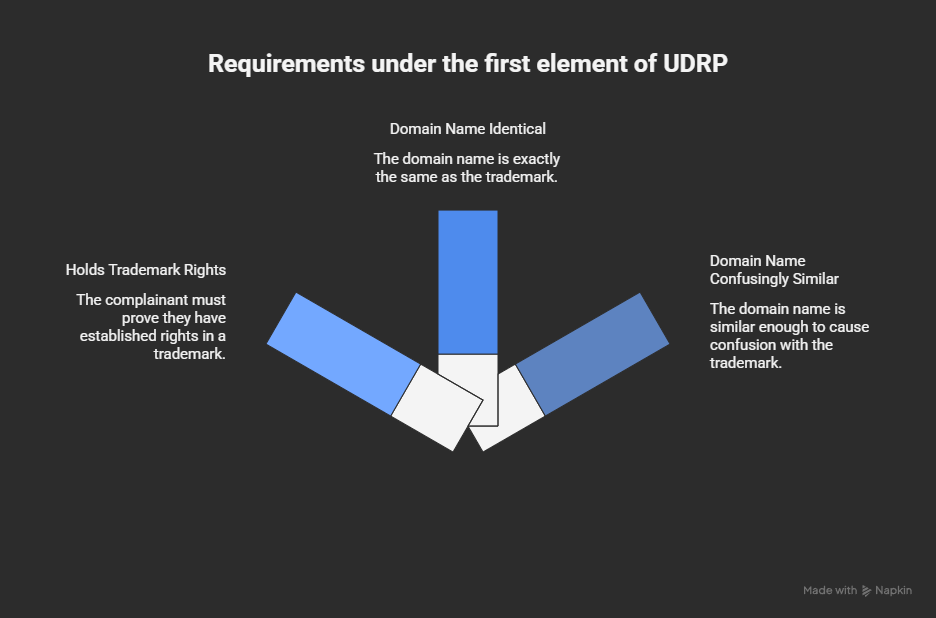
(i) That the domain name is identical or confusingly similar to a trademark or service mark in which the complainant has rights;
(ii) That the domain name holder has no rights or legitimate interest in respect of the domain name; and
(iii) That the domain name has been registered and is being used in bad faith.
The current blog post will analyse the first element in detail. Under the first element of the Policy, a complainant must prove that:
(i) it holds rights in a trademark, and that
(ii) the domain name in dispute is identical, or
(iii) the domain name in dispute is confusingly similar to its trademark.
The first element functions as a standing requirement.
I. Rights in a trademark
The complainant must hold trademark rights at the date of the complaint; a mere pending trademark application would not suffice.
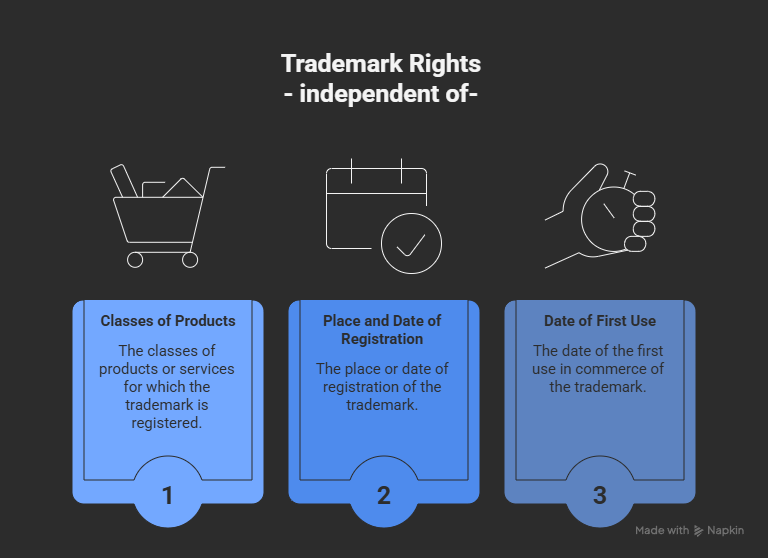
For the first element of the Policy, it has no relevance:
(i) for which classes of products or services the trademark is registered;
(ii) the place or date of registration of the trademark; or
(iii) the date of the first use in commerce of the trademark.
The trademark rights can be registered or acquired by use in commerce.
a) Common law trademarks
If the complainant contends that it acquired trademark rights by use, the complainant must prove that the name has become a distinctive sign which consumers associate with the complainant’s goods and services (secondary meaning) [2].
Relevant evidence must be submitted such as: duration and nature of use of the trademark, the amount of sales, the nature and extent of advertising, the degree of actual public recognition and consumer surveys.
There is a greater onus on the complainant to prove secondary meaning in the case of descriptive terms.
b) Rights regarding personal names
The above requirement is also applicable in case of complainants who want to rely on their personal names.
As such, as held by UDRP panels, complainants should prove that they have used their personal name as a marketable commodity, for a fee, to promote another’s goods or services, or for direct commercial purposes in the marketing of his or her own goods or services.
The personal name should be used in such a manner that a relevant segment of the public comes to recognize the name as a symbol that distinguishes his or her goods and services from those of others.
As the burden of proof rests with the complainants, they should consider the UDRP precedents regarding evidentiary aspects and submit relevant evidence to enable panels to conclude that common law trademark rights have been proven.
Below are a couple of examples of what panels generally accept as evidence of common law trademark rights:
(i) evidence that the complainant has published a certain number of books under his name and offered these for sale (complainant: Emmanuel Macron);
(ii) evidence of use of the website at the disputed domain name (which the complainant owned until inadvertently allowed to lapse) from 1977 through 2018 to promote his speaking engagements and publications (complainant: George Pataki),
(iii) evidence that the complainant founded a prestigious shoe company, she had a role as a fashion director, ownership of a talent and fashion agency, and starred in various TV shows and talk shows. The evidence provided by the complainant included IMDb listings of TV shows she has starred in, an IMDb profile of herself, articles about her publicity, announcements for TV shows, and her Wikipedia page (complainant: Julia Haart).
Merely having a famous name is not of itself sufficient to establish unregistered trademark rights (see section 1.5.2 of the Overview of WIPO Panel Views on Selected UDRP Questions (“WIPO Overview 3.1”).
Panels have rejected claims of unregistered trademark rights in the names of political persons who failed to prove that they were using their names for other purposes than political activities. Nevertheless, claims for unregistered trademark rights have been upheld where, in addition to political activities, the complainant has proven use in commerce of their personal name, for example as journalist, author, and after-dinner speaker/entertainer, like in the UDRP case where unregistered trademark rights in the name of Boris Johnson (the mayor of London at the time) were claimed.
c) Geographical terms
Secondary meaning should also be proven in cases where complainants rely on geographical terms which are not registered as trademarks. This is, however, a rare outcome, as generally trademark registration for the term is required.
d) Circumstances surrounding the registration of the domain name
An additional element that is sometimes accounted for when assessing common law rights is the circumstances surrounding the registration of the domain name in dispute:
“[t]he fact that a respondent is shown to have been targeting the complainant’s mark (e.g., based on the manner in which the mark is used on the related website or impersonating documents or other instruments) may also support the complainant’s assertion and evidence that its mark has achieved significance as a source identifier.” (WIPO Overview 3.1, section 1.3)
However, as correctly pointed out by a learned panelist in a UDRP case “the existence of rights in a trade mark remains an essential part of the UDRP.
The UDRP is not designed to provide a remedy in call cases of wrongdoing on the Internet, and a complainant is required to show an unfair taking advantage of its trade mark rights.
So, for example, it is not sufficient for a complainant merely to demonstrate that a domain name has been used to perpetuate a fraud, if it cannot show that it has rights in a trade mark that is similar to that domain name”.
Therefore, when filing a UDRP complaint based on unregistered trademark rights, complainants should go the extra mile and thoroughly describe and prove how their trademark achieved significance as a source identifier through use.
Sometimes, in limited situations, depending on the circumstances of the case, panels might consider fraud alone as proving limited trademark rights for the purposes of the first element of the Policy, but generally, evidence of trademark rights should be submitted by the complainants.
II. Confusing similarity
As the first element of the Policy functions as a standing requirement, the threshold for finding confusing similarity is not too high.
The trademark would generally need to be recognizable as such within the domain name.
The addition of common, dictionary, descriptive, or negative terms is typically regarded as insufficient to prevent confusion amongst Internet users.
Misspelling of the complainant’s trademark (typosquatting) – e.g. adjacent keyboard letters, substitution of similar-appearing characters, the use of different letters that appear similar in different fonts, inversion of letters and numbers - does not prevent a finding of confusing similarity, but might have a bearing under the second or third element of the Policy.
The Top-Level Domain (“TLD”), such as “.com”, “.club”, “.nyc”, etc., is typically disregarded when assessing confusing similarity under the Policy, as it is viewed as a standard registration requirement. This also applies to new generic top-level domains (gTLDs). However, the TLD might be relevant under the second or the third element to indicate rights or legitimate interests on the respondent’s side or lack thereof (under the second element), or targeting intent or lack thereof (under the third element).
Also, the content of the website at the domain name in dispute is normally disregarded under the first element of the Policy, except in limited circumstances, especially when showing targeting intent.
III. Practical aspects for parties to consider when filing a UDRP complaint or defending against one
a) Practical aspects for the complainants when filing UDRP cases regarding the first element of the UDRP
Submit evidence from the outset on any legal issues that can be anticipated, as the UDRP normally contemplates only one round of submissions; merely conclusory allegations are unlikely to be sufficient.
Submit evidence of trademark registrations, valid at the date of the complaint.
Submit evidence of acquired distinctiveness, when relying on unregistered trademark rights.
Submit evidence of authorization from the trademark owner in case the complaint is filed by an affiliate.
b) Practical aspects for domain name registrants defending their registration regarding the first element of the UDRP
Submit evidence of the dictionary meaning of the domain name in dispute, if that is the case.
Submit evidence of any proceedings showing refusal of the complainant’s trademark application for absolute reasons, particularly if the complainant failed to disclose them, while relying on unregistered trademark rights.
Submit evidence of website content at the domain name in dispute.
About the author:
Mihaela Maravela is a Partner lawyer with Mihaela Maravela Law Office in Bucharest, Romania (member of Maravela Codescu Buliga Attorneys at law). She is an experienced counsel in arbitration, acting under numerous rules, such as ICSID, UNCITRAL, ICC, VIAC, WIPO, CICA-CCIR Rules.

Mihaela sits as arbitrator in domestic and international commercial arbitration and she solved +10 domestic and international commercial arbitrations. She also sits as domain name panelist and she solved over 340 UDRP disputes at the World Intellectual Property Organisation.
She is ranked as a Global Leader in Arbitration and Trademarks since 2018 by Lexology (former WWL).
Mihaela is also experienced in various business sectors such as corporate, M&A, finance & banking, infrastructure, intellectual property, energy, oil & gas, environmental and climate change.
________________
[1] Editors: Stefanie Efstathiou (Independent Practice) and Mihaela Apostol (ArbTech)
[2] Secondary meaning refers to the situation in which a name or term that is not inherently distinctive nevertheless comes to identify, in the minds of the relevant public, a single commercial source as a result of its use in commerce. For example, “American Airlines” - although the words are descriptive, the name has acquired a secondary meaning through long and extensive use and is now recognised by consumers as identifying a specific airline rather than airlines in general.
