
UDRP: The Second Element
(The Domain Name Owner Has No Rights or Legitimate Interest in Respect of the Domain Name)
8 April 2026
As a recap of the previous posts, to succeed in a dispute under the Uniform Domain Name Dispute Resolution Policy (“UDRP” or “Policy”), the complainant must prove three elements:
(i) That the domain name is identical or confusingly similar to a trademark or service mark in which the complainant has rights; [see here]
(ii) That the domain name holder has no rights or legitimate interest in respect of the domain name; and
(iii) That the domain name has been registered and is being used in bad faith.
The current blog post will analyze the second element in detail. To succeed in a UDRP case, a complainant must prove that the respondent has no rights or legitimate interest in respect to the domain name in dispute.
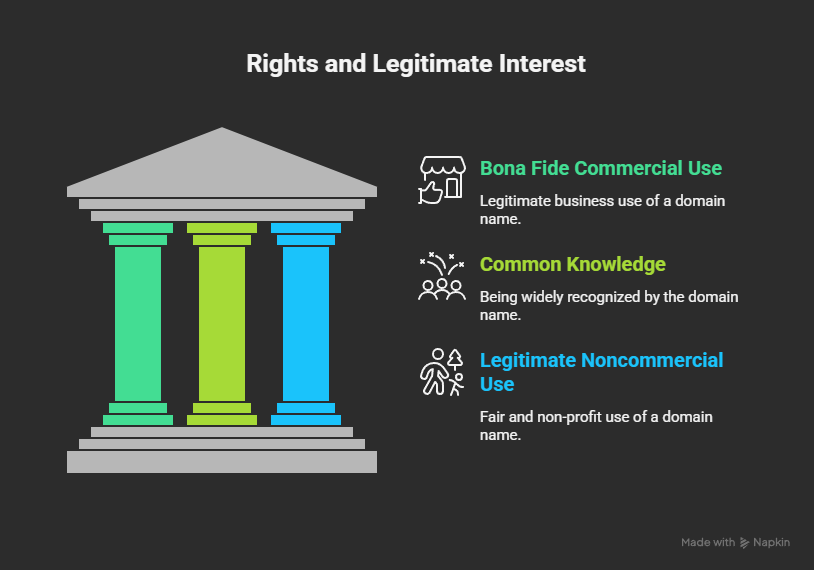
UDRP comprises a few examples which can be construed as evidence of rights or legitimate interest, which in essence are structured on three pillars:
(i) Bona fide commercial use (or contemplated use) of the disputed domain name;
(ii) The respondent is commonly known by the disputed domain name;
(iii) Legitimate noncommercial or fair use of the disputed domain name.
I. Burden of proof
The consensus view of UDRP panels is that the burden of proof in establishing no rights or legitimate interest in respect of the domain name rests with the complainant. It has to show, on a prima facie basis, that the respondent lacks rights or any legitimate interest.
Once such a prima facie case is established by the complainant, the burden of proof shifts to the respondent.
Lack of any evidence from the respondent or any response may lead, together with the rest of the elements of the case, to the conclusion that the respondent does not hold rights or legitimate interest over the domain name in dispute.
II. Bona fide commercial use
a) Independent bona fide business
One possible defense available to the respondents is that the disputed domain name is used for an independent bona fide business.
Panels would accept this defense, if there is no proof of targeting the complainant’s trademark, for example, in cases where respondents operated an independent business in a jurisdiction where the complainant had no registered trademark, or if it results that the respondent has independently and legitimately registered and operated the domain name in dispute in furtherance of its own business, even if at a small scale. Respondent’s lack of a response would not change the outcome, if the publicly available data shows genuine use by the respondent.
However, the defense of genuine use would be rejected, if the panel finds evidence of targeting, for example: if there is no evidence from the respondent of actual use, if the website is still not finalized despite the long use claimed by the respondent, or if the website associated with the domain name in dispute imitates the website of the complainant, despite the respondent’s allegation that it arrived at the domain name based on personal inspiration.
b) Resellers, distributors or dealers
Another possible defense for the respondent would be the use of the domain name by legitimate resellers, distributors or dealers, subject to any agreement between the parties.
The criteria for such use by resellers to qualify as a bona fide offering of goods or services were developed under one of the first decisions rendered under the UDRP, now known as the Oki Data test.
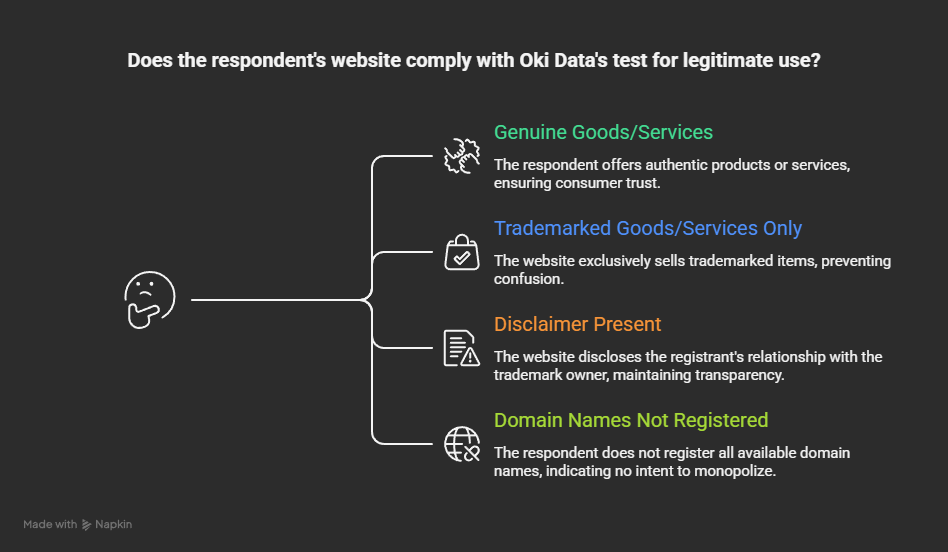
It sets out four cumulative conditions that respondents must meet:
(i) The respondent actually offers genuine goods or services;
(ii) The respondent uses the website to sell only trademarked goods or services;
(iii) The website discloses the registrant's relationship with the trademark owner, typically through a disclaimer; and
(iv) The respondent does not register all available domain names.
Using the above criteria, panels have recognized that resellers, distributors, or service providers using a domain name containing the complainant’s trademark to undertake sales or repairs related to the complainant’s goods or services may be making a bona fide offering of goods and services and thus have a legitimate interest in such domain name.
If the Oki Data requirements are not cumulatively met, panels find that the respondent has failed to demonstrate that it has rights or legitimate interests in the domain name. In assessing this, panels often find that products of competitors are also sold on the website at the disputed domain name, or there is no disclaimer with respect to the lack of a relationship between the parties, or both.
As to the existence of a disclaimer, panels take into account whether the disclaimer is clear and prominent.
If the disclaimer states that the respondent is not an official distributor of the complainant, but it is displayed on the bottom of the website in small fonts, and at the same time the website prominently displays the complainant’s trademark on the top of the homepage, and the homepage imitates the official website of the complainant, the Oki Data test would not be met. Similarly, if the disclaimer is not clear and does not accurately disclose the relationship with the complainant or the lack thereof.
Adding a disclaimer after the notification of the complaint, coupled with the lack of response on the merits, might be considered, depending on the overall circumstances of the case, as an admission of the complainant’s case. Moreover, an offer from the respondent to post a disclaimer could be viewed as an admission by the respondent that the Internet users may be confused.
Due to the risk of misrepresentation, in cases involving a domain name identical to the complainant’s trademark, panels normally find that a respondent lacks rights or legitimate interests.
The Oki Data test is also applied by UDRP panels in cases where the domain name registrant is using the domain name in dispute to provide services that are ancillary to the trademark owner’s or competing with them.
Recently, a panel proposed broadening this criterion, namely, instead of requiring only a disclaimer, the website should be easily distinguishable from the trademark owner’s website, in terms of look and feel, prominent pricing and product presentation. The proposal has so far been met with reluctance.
c) Demonstrable preparations for commercial use
Respondents might also arguewith success that they made preparations to use the domain name in dispute for a bona fide offering of goods or services unrelated to the complainant, its business or trademark.
The evidentiary threshold on such preparations is not high: as UDRP panels have held, “even perfunctory preparations have been held to suffice”.
However, to succeed, respondents should base their defense not on merely conclusory statements, but on actualevidence. As to the type of evidence the panel would expect, it might include, for example, accounts showing trading activity, copies of invoices, advertising and promotional material, copies of relevant website material, and evidence from actual customers.
d) Other situations
Another possible defense for respondents is that they are in the business of domain name investing, especially in cases of reselling premium domain names (comprising descriptive, geographic, and generic terms, common phrases, and combinations thereof).
In such cases, respondents might succeed if the evidence shows they registered the domain name for its inherent meaning, e.g. dictionary meaning, and not to target the complainant, because of the domain name’s value as a source identifier of the complainant’s products, such as in cases where the domain name is put for sale.
In cases where the domain name in dispute resolves to parking pages with pay-per-click (“PPC”) links that direct Internet users to other online locations, the use would not be bona fide where the domain name resolves to a parked page consisting of PPC links to third party websites offering products or services that directly compete with the complainant’s business, given the risk of misleading the Internet users and compete with or capitalize on the reputation and good will of the complainant’s trademark.
The above principle was applied by panels not only in cases where the PPC links directly compete with the complainant’s business, but also in cases where the PPC links on the respondent’s website have no obvious connection with the complainant, under the circumstances of the case, especially where the complainant’s trademark is reputed.
However, respondents might obtain rejection of a complaint, if the PPC links relate to the dictionarymeaning of the words comprising the disputed domain name, or if the respondent made demonstrable preparations to use the name corresponding to the domain name in connection with a bona fide offering of services, or the domain name in dispute was part of a domain name portfolio, the respondent being a domain name investor.
III. The respondent is commonly known by the disputed domain name
Respondents could potentially rely on their personal names to prove they have rights or legitimate interests in a domain name.
If respondents rely on their personal names, they should prove that they used their own surname before the complainant began using its trademark, ideally for a long period of time. In such cases, panels would generallyfind in favour of the respondent.
However, respondents must submit evidence that they are commonly known, rather than simply known, by the domain name in dispute, namely in connection with the business related to the domain name in dispute. Otherwise, their allegations would be rejected by panels, especially if the overall circumstances of the case point to the contrary.
The above principles apply either in the case where individuals rely on their personal names or where companies rely on their corporate names.
IV. Legitimate noncommercial or fair use of the disputed domain name
To support a fair use defense, the respondent might rely on the fact that it uses the domain name for noncommercial free speech, such as criticism. In such cases the respondent’s criticism must be genuine and noncommercial, not a pretext for cybersquatting, commercial activity, or tarnishment (which under the UDRP refers to conduct such as linking unrelated pornographic, violent or drug-related images, or information meant to disparage an otherwise wholesome mark).
If the domain name in dispute is identical to the trademark in which the complainant has rights, fair use is not generally found, as it carries an inadmissible risk of implied affiliation, even in cases where panels look at the content of the website as well.
In case of similar domain names, if the domain name in dispute suggests affiliation, panels generally consider, as with identical domain names, that there is an impermissible risk of association through impersonation. If the domain name includes derogatory terms, the panelsgenerallyconsider that to support a fair use defense relying on free speech, the respondent’s criticism must be based on genuine and noncommercial use, and not a pretext for cybersquatting, commercial activity, or tarnishment.
Importantly, panels do not assess whether the respondent’s criticism is accurate or well-founded; they will merely assess whether the respondent is making a legitimate noncommercial or fair use of the domain name, without intent for commercial gain to misleadingly divest consumers or to tarnish the relevant trademark. A disclaimer could, in some cases, support a conclusion that the website does not appear to be a pretext for cybersquatting, commercial activity, or tarnishment, where there is specific wording pointing to the website’s informative purpose.
V. Other possible defenses of respondents
Respondents might argue they have trademark rights. This might be considered a valid defense, if the circumstances of the case do not indicate that the respective trademark was obtained primarily to circumvent the application of the Policy.
However, such defense would not be upheld if the evidence points to the fact that the trademark registration was sought by the respondent to circumvent the application of the Policy, or otherwise to prevent the complainant’s exercise of its rights, even if only in a particular jurisdiction.
In other situations, respondents might rely on corporate names to substantiate their position, either that they are making a bona fide offering of goods or services, or that they are commonly known by the domain name in dispute. A complaint might be rejected in such cases, even in the absence of a (formal) response. However, such defense would not be upheld in cases of opportunisticregistration or apparently false certificates of incorporation.
VI. Practical aspects for parties to consider when filing a UDRP complaint or defending against one
a) Practical aspects for the complainants when filing UDRP cases regarding the second element of the UDRP
Submit evidence from the outset on any legal issues that can be anticipated, as the UDRP normally contemplates only one round of submissions; merely conclusory allegations are unlikely to be sufficient.
File an amended complaint or a short amendment to the complaint to include specific arguments in cases where the registrant details were not available before the complaint, to address, for example, possible cases of rights or legitimate interests in a domain name by the respondent being commonly known by it, to avoid a finding of Reverse Domain Name Hijacking (RDNH).
In some cases, the websites related to the disputed domain names are taken down after the filing of the complaint. Therefore, the complainants should document how the website was used prior to filing the complaint, to avoid situations where such data is unavailable in the Internet archive.
When the domain name points to an active website, complainants should argue why the activity therein is not genuine. Otherwise, complainants might be found guilty of RDNH, for being silent in their complaint about publicly available information on the respondent’s website, even in the absence of a response from the respondent.
Submit evidence of any illegal activity;
If the complainant’s trademark consists of a dictionary term, the complainant shall prove that its trademark had become distinctive and associated with the complainant before the domain name registration made by the respondent.
b) Practical aspects for domain name registrants defending their registration regarding the second element of the UDRP
Submit evidence of website content at the domain name in dispute.
Document any preparations to use the domain name in dispute in relation to legitimate commercial activity.
___________________________
About the author:

Mihaela Maravela is a Partner lawyer with Mihaela Maravela Law Office in Bucharest, Romania (member of Maravela Codescu Buliga Attorneys at law). She is an experienced counsel in arbitration, acting under numerous rules, such as ICSID, UNCITRAL, ICC, VIAC, WIPO, CICA-CCIR Rules.
Mihaela sits as arbitrator in domestic and international commercial arbitration and she solved +10 domestic and international commercial arbitrations. She also sits as domain name panelist and she solved over 340 UDRP disputes at the World Intellectual Property Organisation.
She is ranked as a Global Leader in Arbitration and Trademarks since 2018 by Lexology (former WWL).
Mihaela is also experienced in various business sectors such as corporate, M&A, finance & banking, infrastructure, intellectual property, energy, oil & gas, environmental and climate change.
________________
[1] Editors: Stefanie Efstathiou (Independent Practice) and Mihaela Apostol (ArbTech)
