
UDRP: The Third Element
(The Domain Name Has Been Registered and Is Being Used in Bad Faith)
28 April 2026
As a recap of the previous posts, to succeed in a dispute under the Uniform Domain Name Dispute Resolution Policy (“UDRP” or “Policy”), the complainant must prove three elements:
(i) That the domain name is identical or confusingly similar to a trademark or service mark in which the complainant has rights (see here);
(ii) That the domain name holder has no rights or legitimate interest in respect of the domain name (see here); and
(iii) That the domain name has been registered and is being used in bad faith.
The current blog post will analyze the third element in detail.
The third element clearly reflects the scope for which the Policy was created: to address cybersquatting cases.
These are cases where third parties register domain names knowing they represent trademarks of others, with the intention of causing damage to the trademark owners and/or exploiting the trademarks to their own advantage.
Such intention cannot generally be established in cases of existing commercial relations between the parties, or if the opposed trademark or the complainant did not exist at the registration of the domain name in dispute.
I. Cumulative requirements of registration and use (which also includes passive holding)
Under the third element of the Policy, the complainant must prove that the disputed domain name has been registered and is being used in bad faith.
This is a conjunctive requirement, therefore, bad faith must exist both at the date of registration and at the date of the complaint.
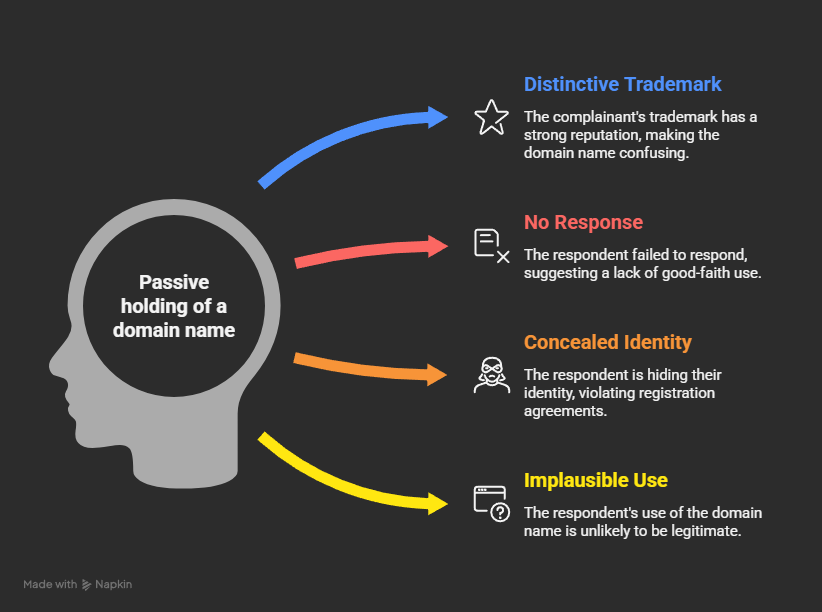
Non-use of a domain name (including a blank or “coming soon” page) would not prevent a finding of bad faith under the doctrine of passive holding. Relevant factors for passive holding include:
The degree of distinctiveness or reputation of the complainant’s trademark;
The respondent’s failure to submit a response or to provide any evidence of actual or contemplated good-faith use;
The respondent is concealing its identity or uses false contact details (noted to be in breach of its registration agreement);
The implausibility of any good faith use of the domain name.
II. Date of the trademark registration
As noted previously, the date of the trademark registration by the complainant is not relevant under the first element. However, it is relevant under the third element, as no targeting intent can generally exist in the absence of trademark rights.
Under the third element, the date when the respondent (not another previous registrant) registered the domain name in dispute is essential to a finding of bad faith. If the domain name in dispute was registered prior to the complainant’s trademark, there is no bad faith.
An exception to the above principle includes those cases where the registration of the domain name in dispute was made in anticipation of the trademark rights of the complainant, such as shortly before or after public announcement of releasing a product, a service, a new company, or other prominent event or following the complainant’s filing of a trademark application.
III. Scenarios of bad faith
Under the Policy, certain non-exclusive scenarios might constitute evidence of a respondent’s bad faith. Other situations might be relevant depending on the circumstances of the case.
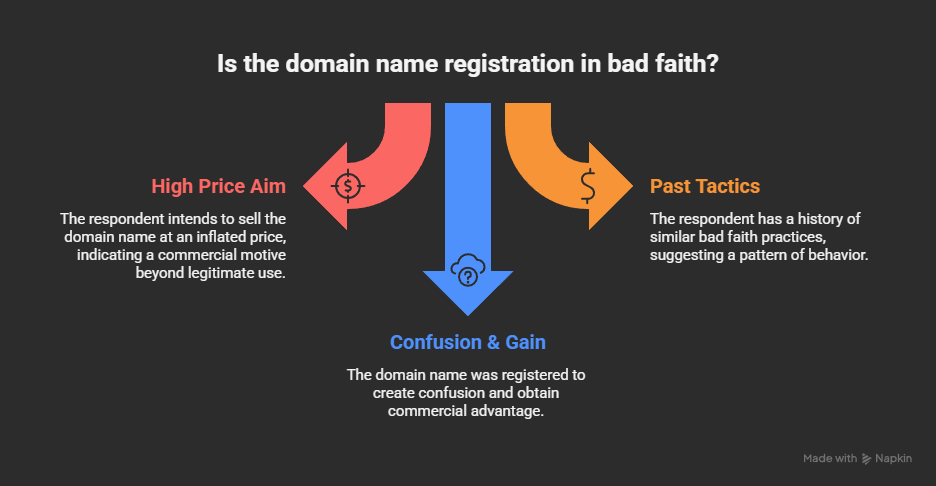
a) The Respondent aims to sell the domain name at a high price
Panels generally find bad faith in cases where the domain name is offered for sale for an amount exceeding the regular registration costs. However, given that domain name selling might be a legitimate business (e.g. dictionary terms are considered valuable assets for domain name investors), the respondent’s offer to sell alone would not suffice to prove the respondent’s bad faith.
Therefore, the overall circumstances of the case are important to show that there is an intent on the respondent’s part to profit from or otherwise exploit the trademark. Panels have held that acquisitions of domain names by domain name investors are legitimate as long as they are not intentionally targeting third-party trademarks.
Such circumstances would typically include the fact that the respondent likely knew of the complainant’s trademark rights, the complainant’s trademark is reputed, the website content shows targeting the complainant, there are threats to point or actually pointing the domain name to trademark-abusive content, or there are threats to “sell to the highest bidder” or otherwise transfer the domain name to a third party, etc.
As such, panels have denied complaints where the domain name in dispute consisted of dictionary words and the complainants have failed to prove that the respondent was aware of the complainant or its trademark or that the respondent had an intention to create confusion and/or capitalize on the value of the complainant’s trademark to attract Internet users to its website for financial gain, noting also that the complainant’s trademark is not a highly distinctive trademark.
Indeed, the less distinctive the trademark, the harder it is for the complainants to establish that the domain name was chosen for its trademark, rather than dictionary value. Therefore, in the case of dictionary terms, the onus is higher for the complainant.
However, respondents arguing they have registered the domain name in dispute for its dictionary meaning should submit evidence that the name is a dictionary term and that they acquired it for use in connection with its relied-upon meaning.
b) The Respondent has engaged in similar tactics before
Generally, a pattern of conduct is found in cases involving well-known trademarks and similar activities targeting such trademarks.
Typical cases include those where the complainant’s trademark is reputed, and the respondent has been involved in previous similar cases where it was found to have targeted other trademarks, and/or the complainant’s trademarks.
In other cases, the respondent was proven to have engaged in a pattern of conduct by successively registering domain names targeting the complainant or the complainant’s related company’s trademarks.
However, a pattern of bad faith would not be found in the absence of proof of targeting.
Such cases might include either those where the complainant fails to prove that its trademark is reputed (or is only reputed in a line of business or to a limited territory), and/or the respondent claims to have registered the domain name for its dictionary meaning or its value, as a domain name investor, and not to target the complainant.
If the identification data for the respondent is insufficient to determine a pattern of conduct with respondents in previous cases, panels generally refrain from finding a pattern of conduct in the meaning of paragraph 4(b)(ii) of the Policy.
Also, panels are reluctant to find a pattern of abuse where a single UDRP case merely contains two domain names registered simultaneously by the same respondent directed at a single complainant mark.
c) The Respondent registered the domain name to create confusion and obtain commercial gain
In case of domain names identical or confusingly similar to reputed trademarks, panels generally find there is a presumption of bad faith.
Panels generally find evidence of bad faith when the respondent registers a domain name to attract, for commercial gain, Internet users to its website by creating a likelihood of confusion with the complainant’s mark, both where there is actual confusion, or only an intent to cause confusion (including by technical means beyond the domain name itself) for the respondent’s commercial benefit, even if such attempt is unsuccessful, or in cases of redirection of the domain name to the complainant’s website or of one of its competitors.
Use of a disputed domain name for illegitimate activity, such as the sale of counterfeit goods or phishing, is manifestly considered evidence of bad faith.
As with all the other elements under the Policy, the burden of proof rests on the complainants. In case of counterfeit allegations, conclusory allegations are unlikely to be sufficient. To discharge the burden of proof, the complainants should submit a well-pleaded case, supported with appropriate evidence.
Depending on the factual circumstances of each case, the panels are prepared to accept circumstantial evidence that the goods are counterfeit. Such evidence could include, for example, situations where the prices of the goods sold on the respondent’s website were heavily discounted compared to the original products.
d) Further circumstances of bad faith considered by panels
The nature of the domain name (e.g., a typo of a widely known trademark, or a domain name incorporating the complainant’s trademark plus an additional term such as a descriptive or geographic term, or one that corresponds to the complainant’s area of activity or natural zone of expansion).
The chosen top-level domain (e.g., particularly where corresponding to the complainant’s area of business activity or natural zone of expansion).
The content of any website to which the domain name directs, including any changes in such content and the timing thereof.
The timing and circumstances of the registration (particularly, following a product launch, or the complainant’s failure to renew its domain name registration).
Respondent’s behavioral pattern of targeting trademarks along a range of factors, such as a common area of commerce, intended consumers, or geographic location.
A clear absence of rights or legitimate interests coupled with no credible explanation for the respondent’s choice of the domain name.
Other indicia generally suggesting that the respondent had somehow targeted the complainant.
IV. Practical aspects for parties to consider when filing a UDRP complaint or defending against one
a) Practical aspects for the complainants when filing UDRP cases regarding the third element of the UDRP:
Submit evidence from the outset on any legal issues that can be anticipated, as the UDRP normally contemplates only one round of submissions.
Merely conclusory allegations are unlikely to be sufficient.
File an amended complaint or a short amendment to the complaint to include specific arguments in cases where the respondent’s details were not available before the complaint, for example, discovering evidence or indicia that shows the respondent’s pattern of conduct.
Submit evidence of the complainant’s reputation and the reach of its trademarks, not only self-published on its websites, but also independent derived material.
Submit details of the complainant’s trademark registration(s) and market presence at the location of the respondent.
b) Practical aspects for the respondents when filing UDRP cases regarding the third element of the UDRP
Submit evidence to support explanations for choosing the disputed domain name, either for its dictionary meaning, or for investing purposes, or any other reason.
Submit evidence that the domain name is a dictionary term or a generic term used in an industry.
Submit evidence of conducting a legitimate and independent business of that of the complainant.
Submit evidence of the geographical location of its business.
Show that the complainant had no market presence in the respondent’s area.
Submit evidence of any prior or parallel court disputes between the parties.
___________________________
About the author:

Mihaela Maravela is a Partner lawyer with Mihaela Maravela Law Office in Bucharest, Romania (member of Maravela Codescu Buliga Attorneys at law). She is an experienced counsel in arbitration, acting under numerous rules, such as ICSID, UNCITRAL, ICC, VIAC, WIPO, CICA-CCIR Rules.
Mihaela sits as arbitrator in domestic and international commercial arbitration and she solved +10 domestic and international commercial arbitrations. She also sits as domain name panelist and she solved over 340 UDRP disputes at the World Intellectual Property Organisation.
She is ranked as a Global Leader in Arbitration and Trademarks since 2018 by Lexology (former WWL).
Mihaela is also experienced in various business sectors such as corporate, M&A, finance & banking, infrastructure, intellectual property, energy, oil & gas, environmental and climate change.
