
Constitutional AI Frameworks: A New Frontier for Ethical AI in Dispute Resolution
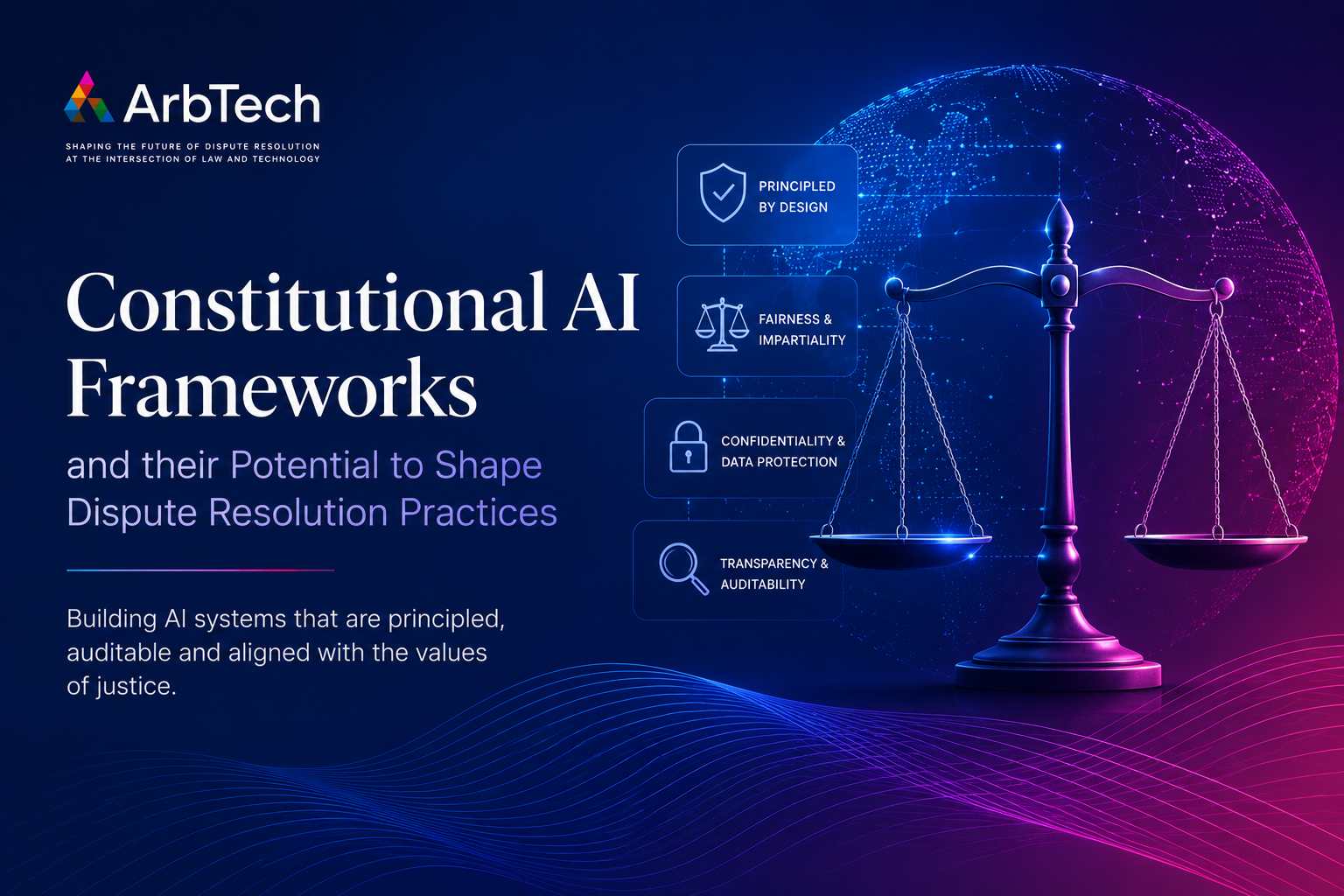
Can AI be designed to reason more like a principled decision-maker rather than simply a powerful prediction engine? A new paper by Fernanda Dias and Sophie Nappert explores how Constitutional AI (CAI) and Constitutional Classifiers (CCs) could help shape the future of dispute resolution by embedding legal and ethical principles directly into AI systems.
As artificial intelligence becomes increasingly integrated into legal practice, the conversation is shifting from whether AI should be used to how it can be deployed responsibly. While AI offers significant opportunities to improve efficiency, reduce costs and enhance access to justice, it also raises fundamental questions about fairness, transparency and accountability.
The paper examines Constitutional AI (CAI), an approach pioneered by Anthropic that trains AI models using a "constitution" of natural-language principles rather than relying solely on human feedback. Instead of merely filtering problematic outputs after they are generated, Constitutional AI encourages models to critique and revise their own reasoning in line with values such as impartiality, due process, confidentiality and fairness.
Alongside CAI, the authors discuss Constitutional Classifiers (CCs), which provide an additional layer of protection by monitoring both user inputs and AI outputs in real time. These classifiers are designed to prevent harmful or inappropriate content before it reaches users, strengthening the overall reliability and safety of AI systems.
The paper explores how these technologies could be applied across dispute resolution, particularly in international arbitration. Potential applications include:
Producing balanced evidence summaries without drawing premature legal conclusions.
Assisting with procedural management while respecting party autonomy.
Protecting confidential information and privileged communications.
Supporting consistency across jurisdictions by embedding institutional rules and procedural standards.
Enhancing transparency by making AI reasoning more explainable and auditable.
Beyond the technical aspects, the authors also consider broader governance questions. As constitutional approaches are developed by private technology companies, they ask how these underlying principles can become publicly accountable, independently auditable and suitable for use within judicial and governmental systems.
Rather than presenting Constitutional AI as a complete solution, the paper argues that these emerging frameworks offer a promising direction for developing AI tools that better reflect the values underpinning dispute resolution. As AI continues to reshape legal practice, constitutional approaches may help bridge the gap between technological innovation and procedural justice.
Read the full paper to explore how Constitutional AI could help build more transparent, trustworthy and ethically aligned AI systems for dispute resolution.
