
The Future of the UDRP: ICANN‘s Expected Review and the WIPO–ICA Final Report
I. Background
The Uniform Domain Name Dispute Resolution Policy (“UDRP” or “Policy”) emerged during the rapid commercialisation of the Internet and is effective since 1999. It has been implemented ever since with only minor, non-substantial amendments in 2024. The UDRP has now been facilitating the dispute resolution of cybersquatting cases (see here more details) for 27 years. It has been a global standard for out-of-court domain name dispute resolution and has created a large body of case law.
After 27 years, the digital world has certainly evolved and new challenges are in the center of the market’s and policymakers’ attention, such as the ever-changing landscape of more complex forms of abuse including those that may not yet be detectable due to the use of new technologies. At the same time, the significance of a reliable and efficient resolution mechanism, such as the UDRP, became more evident.
The Internet Corporation for Assigned Names and Numbers (“ICANN”), as the responsible authority for the Policy, following the multistakeholder model, in which individuals, businesses, civil society, governments, and technologists play important roles in its community-based, consensus-driven, policymaking approach,[1] has put in place review mechanisms of its processes and policies. In light of the above, ICANN had announced two review phases, i.e. Phase 1 (concerning the 2012 New gTLD Program) and Phase 2 (concerning the UDRP). The review was divided into two phases because the mechanisms introduced for the 2012 New gTLD Program raised different questions from those concerning the UDRP.
Phase 1
In March 2016, the Generic Names Supporting Organization (“GNSO”) Council initiated the so-called Policy Development Process (“PDP”) to review the rights protection mechanisms applicable to generic top-level domains (“gTLD”),[2] following the 2012 New gTLD Program (see more details here). The overall objective was to assess whether the mechanisms continued to fulfil their intended purposes and whether additional policy recommendations were necessary. Thus, Phase 1 did not review the UDRP itself.
Phase 2
Phase 2 is intended to examine the UDRP. However, this phase has been delayed. Following ICANN’s UDRP Policy Status Report in 2022,[3] the GNSO Council deferred the next steps of Phase 2 several times. The only certainty was that the Council intended to first consider revisions to the Policy Development Process Charter (PDP Charter) (a foundational document that defines the mission, scope, goals, and operational timeline for a policy-making working group, used within ICANN by GNSO), in order to clarify and narrow the scope of the review. The GNSO Council’s May 2025 Resolution specifically deferred the launch of a Charter Drafting Team, which will be responsible for defining the questions the eventual “UDRP Working Group” is expected to address.
In the meantime, in December 2025, WIPO and the Internet Commerce Association (“ICA”) published their independent Final Report of the WIPO–ICA UDRP Review Project Team (“Final Report”).[4] The WIPO–ICA UDRP Review Project is a joint initiative bringing together experienced UDRP practitioners and stakeholders to assess potential improvements to the UDRP (the “Project Team”). Its Final Report is not part of ICANN’s formal Phase 2 process and does not amend the UDRP; rather, it is intended to serve as expert input for the forthcoming review by identifying areas of consensus, issues requiring further study, and possible avenues for targeted reform. The GNSO Council welcomed the Final Report and noted that it would be a useful resource, however further organisation and decisions on Phase 2 shall be subject to the Council’s prioritisation and planning. Therefore, the official launch is still pending.
II. The Final WIPO-ICA Report: Explained
The Final Report’s central recommendation is mainly that ICANN preserves stability and continuity of a system that has served the community well for 27 years and concentrate first on reforms for which consensus is realistically achievable. More importantly, the Final Report recognizes that the consensus approaches, which have been shaped over many years, should be identified and maintained, “unless there is compelling evidence supporting a change which does not destabilize the procedure and which enjoys consensus support”.[5] A further understanding should be that the UDRP remains a procedure for resolving cybersquatting cases and maintains its trademark-based framework, even if other types of identifiers may be an area of interest for some stakeholders.[6]
The Final Report divides the issues into four categories according to the degree of agreement among the Project Team and the amount of further work required. Below is the list of identified issues and proposals by category, along with short explanatory notes of what each proposal entails.
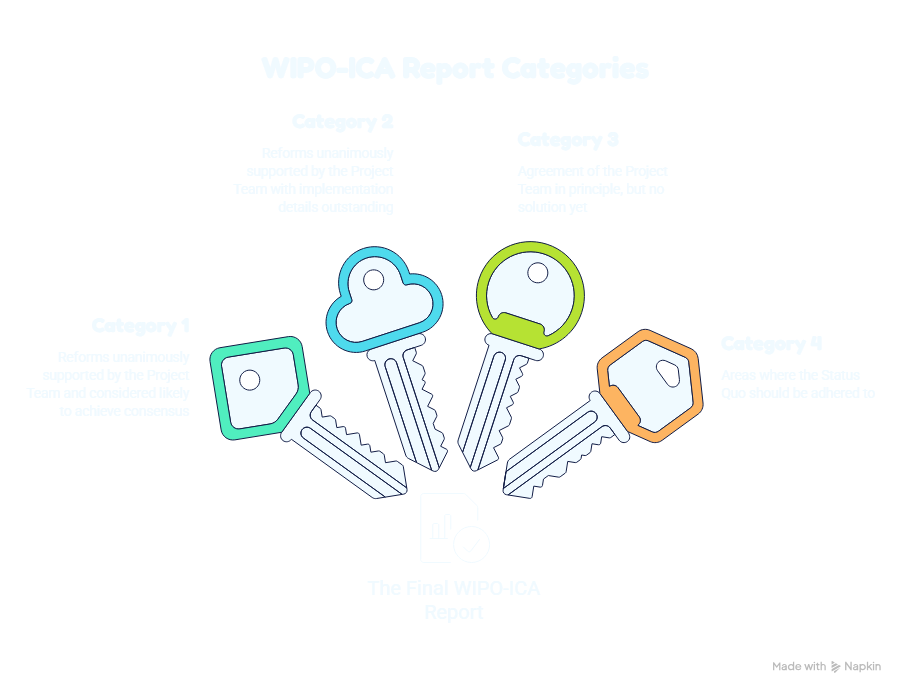
Category 1 – Reforms unanimously supported by the Project Team and considered likely to achieve consensus
These are the changes the Project Team considers should be prioritised in Phase 2 and would appear readily implementable. The main recommendations are:
Supplemental filings: The proposal refers to establishing a consistent procedure governing unsolicited supplemental filings, including when they are permissible and their parameters (e.g. length or contents). At present, practices are inconsistent and such filings can unnecessarily increase cost and delay. However, the administrative burden on dispute resolution providers and the time and effort required by the parties and the panelists should be taken into account (see more details here).
Fee payment deadlines: The introduction of a fixed deadline for payment of additional fees in three-member panel cases, has been proposed.
ICANN Registrar compliance: Strengthening ICANN's role in ensuring that Registrars comply promptly with UDRP obligations, particularly domain locks (a security setting provided by ICANN and domain registrars that prevents your domain name from being accidentally or fraudulently transferred to another provider) and implementation of decisions, is seen as crucial. Moreover, streamlining or automating post-decision transfers should be considered.
Registrar training and information: ICANN should produce guidance and informational resources for Registrars, registrars should participate in relevant training, and each Registrar should have a designated contact for post-decision transfers.
Regulating withdrawal of complaints: Withdrawal by complainants after proceedings have commenced is not regulated uniformly among providers and the Rules for Uniform Domain Name Dispute Resolution Policy (“UDRP Rules”) do not address the situation where such withdrawal is done without the respondent’s consent. Therefore, the Final Report's proposal is to amend the UDRP Rules to require consent of both parties and make the procedure uniform across all providers.
Registrar verification procedures: Standardisation of the information provided by registrars is welcomed. Verification should clearly identify the domain's creation date, the date on which the registrar became registrar of record, and registrant contact information, with the information shared with the parties and panel. Automation of registrar-provider exchanges should also be considered.
Dissenting panelists: In very rare occasions, dissenting panelists have not been identified. Therefore, the proposal is to require all such panelists to be identified in published decisions, principally as a matter of transparency.
ICANN’s financial contribution to the UDRP: The UDRP’s good functioning is certainly generating an important income. The proposal is centered around the consideration of using a portion of registration-related funds received by ICANN to support the UDRP—for example through reduced filing fees for Small and Medium Enterprises or non-profits, training, panel remuneration, or development of guidance.
Educational materials: The Project Team sees a need to create neutral, standardised information for complainants and respondents explaining the requirements of the UDRP, evidentiary expectations, legitimate interests, and the risk of Reverse Domain Hijacking (“RDNH”) (see more details here). This task should be undertaken by ICANN.
Notice by Registrars: It is the opinion of the Project Team that in some instances, respondents do not recognise a provider’s notice in a UDRP proceeding, since they may not be familiar with the process or the fact that they bound themselves upon registration of a domain to the UDRP. Therefore, it is proposed that the Registrars or their resellers should also send to their customers an additional notification that a UDRP proceeding has commenced. This would supplement, not replace, formal notice from the provider and would not affect procedural deadlines. The Final Report also suggests reconsidering whether hard-copy courier notice remains necessary.
Decision format: Encouraging all providers to use a consistent section-by-section structure, with the WIPO format cited as a possible best-practice model, is proposed. The Final Report does not favour imposing a technically burdensome machine-readable format.
UDRP jurisprudence: Exploring a pan-provider summary of UDRP case law, building on the consensus positions reflected in the WIPO Overview, is something that the Project Team considered. Interestingly, the Final Report suggests that this exercise could be undertaken outside the formal ICANN PDP, with input from experienced UDRP stakeholders. Furthermore, a question arose as to whether interpretive guidance or “rules” arising from such jurisprudence should be codified within the UDRP Policy itself as a binding interpretative tool across all providers and panelists.
Category 2 – Reforms unanimously supported by the Project Team with implementation details outstanding
This category contains the proposals that could materially change UDRP practice. Thus, the Project Team considers solutions desirable and potentially achievable but recommends dedicated specialist work tracks for their further specification.
Appeals: The Project Team was in principle supportive of creating an internal UDRP appeals mechanism. The rationale is to provide a less expensive means of correcting occasional erroneous decisions, offer recourse where national law may not provide an obvious cause of action, and potentially improve consistency in UDRP jurisprudence. However, questions remain over who should hear appeals, whether appeals should be confined to single-member decisions, whether the evidentiary record should be closed, the applicable deadline and fee, and whether appellate decisions should create binding precedent. The Final Report therefore recommends a dedicated Phase 2 work track composed particularly of persons with practical UDRP and litigation experience.
Remedy - True cancellation: At present, cancellation normally returns the disputed domain name to the pool of names capable of registration, creating a risk that the cybersquatter—or another bad actor—simply registers it again. The Final Report proposes considering a form of cancellation that genuinely removes the domain from circulation, while also developing a mechanism allowing the restriction to be lifted where a third party later demonstrates a legitimate basis for registering it. This would require input from both registries and registrars. The example of the Australian country-code top-level domain (“ccTLD”) Registry – auDA – is mentioned in the Final Report, which provided for a policy under which a third party was allowed to ask that a domain name be lifted from its cancelled/suspended state upon the showing of a legitimate claim to the domain name.
Third-level domain names: The Final Report recommends examining whether UDRP-type protection should apply where trademark abuse occurs at the third level—for example, brand.example.com. Rather than necessarily changing the UDRP itself, one possibility identified is requiring second-level registrants who commercially issue third-level registrations to incorporate the UDRP into their own contractual arrangements.
Changing “and” to “and/or”: This is one of the most legally significant proposals. Paragraph 4(a)(iii) of the Policy presently requires a complainant to establish that the domain was both registered and used in bad faith. The Final Report recognises situations in which registration was originally in good faith, but later use became plainly abusive—for example, after the termination of a licence or business relationship. It does not recommend simply replacing “and” with “or” across the board. Instead, it recommends examining whether “and/or” could apply in narrowly defined circumstances, together with express safeguards protecting domains genuinely registered in good faith. This should be considered in a dedicated Phase 2 work track.
Expedited or summary proceedings: The Final Report supports exploring a faster route for particular categories of obvious or urgent abuse, especially repeated targeting of brands and fraud-related cases. Possible models considered include faster and cheaper default decisions, special treatment of repeatedly targeted trademarks, temporary suspension in uncontested cases, and procedures for time-sensitive fraud. No particular model is endorsed; the Final Report recommends a dedicated work track to design a mechanism that accelerates enforcement while protecting legitimate registrants.
Category 3 – Agreement of the Project Team in principle, but no solution yet
This category lists topics which would need further work and for which a solution is worth pursuing:
Name redaction: Panels already have the ability to redact names in appropriate circumstances, particularly where identity theft or privacy concerns are involved. The Final Report, therefore, does not consider that a UDRP Policy or UDRP Rules amendment is necessarily required. It does, however, suggest considering a more uniform framework or criteria governing redaction, balancing privacy against transparency and the legitimate need to identify repeat cybersquatters, repeat RDNH complainants, and other relevant procedural histories.
Panelist appointment, accreditation and quality: Issues include appointment methodology, accreditation and re-accreditation, continuing education, neutrality, procedures for raising concerns about panelist performance, and whether panelists should simultaneously be permitted to act as counsel in other UDRP proceedings. The Final Report recognises these as important but considers consensus difficult. It specifically points to continuing education and a potential process for raising performance concerns as areas worth exploring.
Free speech: The Final Report considers legitimate free speech already protected through the UDRP's recognition of non-commercial fair use and the developed jurisprudence – especially when taking into the Final Report of the First WIPO Internet Domain Name Process of 1999, at Paragraph 172: “Domain name registrations that are justified by legitimate free speech rights or by legitimate non-commercial considerations would likewise not be considered to be abusive”.
However, the Final Report recommends a dedicated examination of free-speech cases and possible clarification or codification of the case law to improve consistency between panels.
Expanding the scope of the UDRP: Suggestions have included geographical indications, personal names, trade names, copyright and other identifiers. The Project Team deliberately focused its Final Report on the existing trademark-based UDRP and leaves the question whether Phase 2 should examine an expansion of scope to the GNSO Council when determining the Phase 2 Charter.
Category 4 – Areas where the Status Quo should be adhered to
The Final Report advises against major reform on the following issues:
Loser pays, costs and damages: Even though there is sympathy for compensating successful parties, the enforcement and administrative problems that this solution or reform would entail were considered too substantial. The Final Report therefore recommends against a loser-pays system.
Mediation: The Final Report dealt with the idea of mandatory mediation, on the basis that a number of ccTLDs employ mediation as one of their dispute resolution mechanisms (such as .ch, .fr, etc.). However, its functioning within the context of the UDRP was questioned and therefore, the verdict was that mandatory mediation should not be introduced. Providers should nevertheless remain free to offer voluntary mediation where both parties agree.
Laches / statute of limitations: The Final Report recommends no limitation period for UDRP complaints and sees no sufficient basis for formally changing the UDRP to introduce laches. Delay can already be—and is—taken into account by panels when assessing the merits and evidence.
The forthcoming Phase 2 review certainly presents an important opportunity to modernise the UDRP without undermining the features that have made it an effective golden standard for more than two decades. However, the timing of the review will be critical as the Internet and new technologies create evolving abuses, even in the limited context of a trademark-based framework or in relation to the procedural safeguards that such administrative proceedings need to have in place. Consequently, it is of great importance to move with the review forward as soon as possible, and certainly after having narrowed down the scope and the length of the review.
———————————————————————————————————————————
About the author:

Stefanie Efstathiou is a dual-qualified lawyer (Greece and Germany) specializing in Intellectual Property, AI, Data Protection and Alternative Dispute Resolution, with particular expertise in domain name disputes. She serves as in-house counsel at DENIC eG, the registry for .de domain names, and acts as a panelist for several domain name dispute resolution providers. Her academic and professional work lies at the intersection of technology and ADR, where she is also pursuing a PhD at the Ludwig Maximilian University (LMU) in Munich on AI and Arbitration. In addition to her academic engagement, she also contributes as a member of an international task force developing guidelines on the use of AI in Arbitration, and regularly engages in conferences, professional networks, and publications in this field.
———————————————————————————————————————————
Editors: Mihaela Maravela (Maravela Legal) and Mihaela Apostol (ArbTech)
[1] ICANN, About ICANN, https://www.icann.org/resources/pages/about-icann.
[2] ICANN, Policy Status Report, https://www.icann.org/en/public-comment/proceeding/policy-status-report-uniform-domain-name-dispute-resolution-policy-udrp-03-03-2022; ICANN, GNSO, Phase 1 Final Report, https://gnso.icann.org/sites/default/files/file/field-file-attach/rpm-phase-1-proposed-24nov20-en.pdf?utm_source=chatgpt.com.
[3] ICANN, UDRP Policy Status Report, https://www.icann.org/en/public-comment/proceeding/policy-status-report-uniform-domain-name-dispute-resolution-policy-udrp-03-03-2022.
[4] WIPO-ICA, Final Report of the WIPO-ICA UDRP Review Project Team, https://www.wipo.int/export/sites/www/amc/en/docs/wipo-ica-final-udrp-review-report_dec2025.pdf.
[5] Id, p. 9.
[6] Id, p. 9.
