
Procedural Issues in Domain Name Disputes (Part I)
I. Introduction
While much of the discussion surrounding the Uniform Domain Name Dispute Resolution Policy (“UDRP” or “Policy”) focuses on the three substantive elements that complainants need to prove under para. 4(a) UDRP, the procedural framework of the UDRP is equally central to its effectiveness. The UDRP was deliberately designed as a fast, cost-efficient, and largely document-based administrative procedure to address clear cases of cybersquatting, and its procedural features reflect this objective.
The Rules for the Uniform Domain Name Dispute Resolution Policy ("UDRP Rules") complement the UDRP and set the procedural ground rules of the UDRP proceedings, together with the supplemental rules of the relevant dispute resolution provider.
This blog post, which will be presented in two parts, aims to examine the most significant procedural issues that may arise in UDRP proceedings, offering an overview of the various questions that frequently emerge throughout the course of such disputes. In doing so, it seeks to highlight both the practical and legal complexities of the UDRP procedural framework.
This Part I will analyse the following procedural aspects: (i) document-based proceedings; (ii) language; (iii) supplemental filings; (iv) consolidation; and (v) settlement.
II. Key Procedural Issues
1. Primarily Written and Document-Based Procedure
The UDRP proceedings are designed to have a single round of pleadings based on documents, i.e. the complaint and the response. Unlike court litigation and arbitration proceedings, according to para. 13 of the UDRP Rules, the UDRP does not provide for in-person or witness hearings (incl. online or web-based solutions), discovery or cross-examination. Even though para. 13 of the UDRP Rules gives discretionary power to the panel to conduct physical hearings, when necessary, it is noted that this shall be the case only in exceptional circumstances. So far, no UDRP proceeding is known to have taken place in-person.
2. Language of the Proceedings
Pursuant to para. 11(a) of the UDRP Rules, unless otherwise agreed by the parties, the default language of the proceedings is the language of the registration agreement, subject to the panel’s authority to determine otherwise.
In light of the objective of ensuring an efficient and expeditious procedure, para. 10 of the UDRP Rules grants panels broad discretion to manage proceedings as they deem appropriate. This discretion is, however, constrained by the requirement to uphold procedural fairness, in particular, by ensuring equal treatment of the parties and affording each party a reasonable opportunity to present its case.
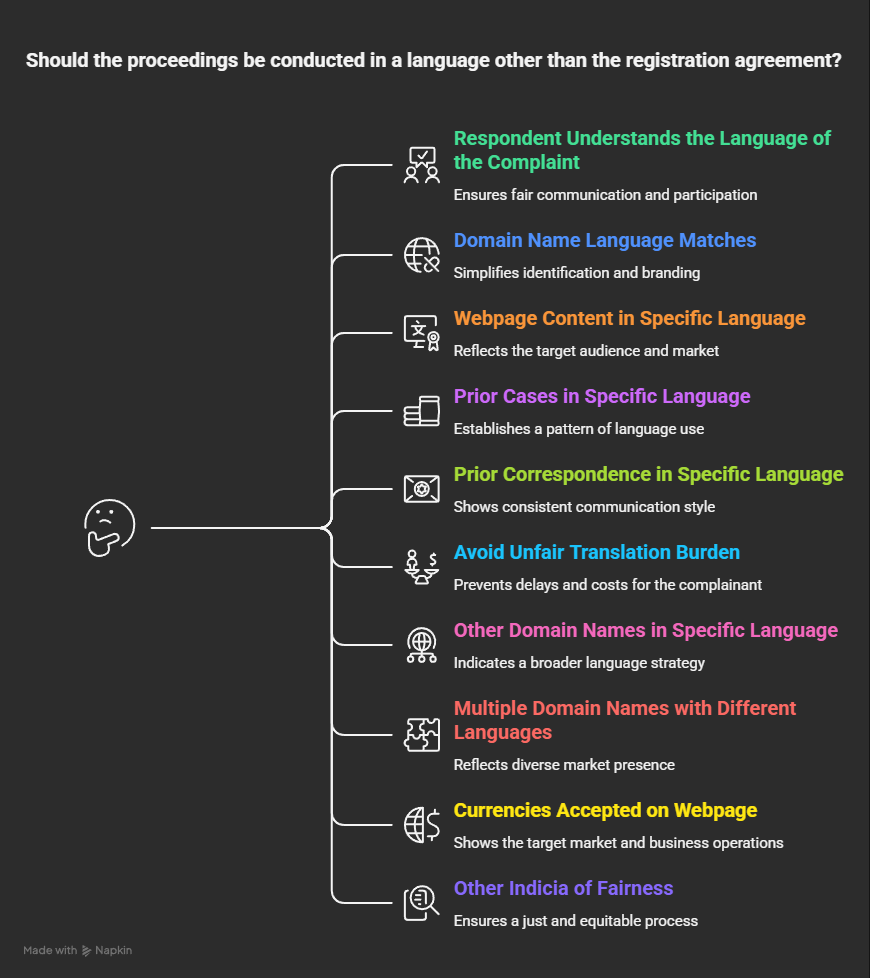
Within this framework, panels have recognized that, in certain circumstances, it may be appropriate to conduct the proceedings in a language different from that of the registration agreement by considering a range of factors, such as:
(i) Evidence showing that the respondent can understand the language of the complaint;
(ii) The language/script of the domain name, particularly, where it is the same as that of the complainant’s mark;
(iii) Any content on the webpage under the disputed domain name;
(iv) Prior cases involving the respondent in a particular language;
(v) Prior correspondence between the parties;
(vi)Potential unfairness or unwarranted delay in ordering the complainant to translate the complaint;
(vii) Evidence of other respondent-controlled domain names registered, used, or corresponding to a particular language;
(viii) In cases involving multiple domain names, the use of a particular language agreement for some (but not all) of the disputed domain names;
(ix) Currencies accepted on the webpage under the disputed domain name; or
(x) Other indicia showing that it would not be unfair to proceed in a language other than that of the registration agreement.
In cases where the complainant submits the complaint in a different language than that of the registration agreement, the dispute resolution providers, such as the World Intellectual Property Organization (“WIPO”), will typically notify the parties of the discrepancy and invite the complainant either to provide a translation of the complaint or to submit reasons why the proceedings should continue in the language of the complaint. The respondent is then given an opportunity to comment or object, while the final determination on the language of the proceedings remains with the panel under para. 11 of the UDRP Rules.
<puydufouuk.com> et. al.[1]
This case is the perfect example of a panel deciding on the issue of the language of the proceedings by relying on its discretion under para. 11(a) UDRP Rules. The issue arose because the Complaint was filed in English, while the Registrar confirmed that the language of the Registration Agreement was Spanish.
The Center invited the Parties to comment on the appropriate procedural language, where each Party argued in favor of their preferred language.
The Panel considered that the disputed domain names themselves contained English geographic terms (“UK” and “USA”), indicating familiarity with English, that both Parties communicated their requests for the language of the proceedings in English and that the Respondent had answered to the Complainant’s prior right letters in English. It also noted the need to avoid unnecessary delays and expenses that would arise from requiring translation of the Complaint.
Thus, and in accordance with the powers granted under para. 11(a) of the UDRP Rules, the Panel decided that the language of the proceedings shall be English.
<xiaocostco.com>[2]
In this case, the Registration Agreement was in Chinese, while the Complaint was filed in English. The Respondent was a company located in Beijing, China and therefore, the Panel assumed that English is not the Respondent’s first language. The Complainant, the well-known company COSTCO, submitted several arguments to conduct the proceedings in English, such as that the use of Latin characters in the disputed domain name showing that the Respondent understands English. The Panel did not agree with that logic. However, to avoid unnecessary costs and delay, the Panel accepted the Complaint in English without requiring a Chinese translation, while deciding to issue the final decision in Chinese. The panel considered this approach fair to both parties and consistent with procedural efficiency.
<auchan.xyz>[3]
Here, the Registration Agreement was in Chinese. The Complainant requested that the proceedings be conducted in English, arguing that it was based in France, had no knowledge of Chinese, and that requiring translation would create disproportionate cost and delay. It also pointed to the use of Latin characters in the disputed domain name as an indication that the Respondent was familiar with languages beyond Chinese.
The Respondent, an individual based in China requested that the language of the proceedings be Chinese. Parts of his submissions were in English, claiming to have been translated using the Baidu online translation facility, since he does not know the English language. Nevertheless, the Panel determined that English was the appropriate choice. It noted that the disputed domain name and other domain names registered by the Respondent incorporated well-known foreign brands in Latin script, suggesting familiarity with English. The Panel also found that the Respondent’s submissions demonstrated an understanding of the claims and that adopting English would not unfairly prejudice the Respondent.
3. Supplemental Filings
Supplemental filings in a UDRP proceeding are not common and generally discouraged. Under paras. 10 and 12 of the UDRP Rules, panels have broad discretion to manage the proceedings, including determining the admissibility, relevance, materiality, and weight of evidence, as well as requesting any additional statements or documents they consider necessary for deciding the dispute.
When unsolicited supplemental filings are received, panels usually require the submitting party to demonstrate both the relevance of the additional material and why it could not reasonably have been included earlier in the complaint or response, for example due to unforeseen or exceptional circumstances.
<xcarb.org> et. al.[4]
In this case before the Czech Arbitration Court (“CAC”), the Complainant filed an unsolicited supplemental filing. The Panel noted that unsolicited supplemental filings are generally not contemplated under the UDRP Rules, unless additional submissions are requested by the panel or filed to cure procedural deficiencies.
Relying on its discretion under para. 10(b) of the UDRP Rules, the Panel rejected most of the Complainant’s supplemental filings, finding that the information could have been presented in the original Complaint. However, it allowed certain parts addressing whether the Respondent was a competitor, as this issue arose only from statements first made in the Response and therefore considered only this part to be admissible.
<redmountain.com>[5]
In this case before the Forum, the Panel noted that, under Forum’s Supplemental Rules, additional written submissions may be forwarded to the panel, but their acceptance remains entirely within the panel’s discretion.
However, as neither Party satisfied this standard of demonstrating both the relevance of the supplemental filings and why they could not have been presented earlier, the Panel dismissed them and went one step further noting such submissions may undermine the efficiency and finality that the UDRP process is intended to preserve.
4. Consolidation
Consolidation scenarios may vary, and panels assess them on a case-by-case basis, with the burden resting on the party seeking consolidation to justify why it should be permitted. While dispute resolution providers may accept a consolidated complaint on a preliminary basis, in accordance with para. 10(e) of the UDRP Rules, the final decision of consolidating multiple domain name disputes lies with the appointed panel.[6]
i) Multiple respondents
One possible scenario is where one complainant files a complaint against multiple respondents. In this case, panels assess a number of factors, but typically whether the disputed domain names or related websites appear to be under common control and whether consolidation would be equitable to all parties. Relevant indicators may include similarities in registrant details, contact information, hosting infrastructure, website content, naming patterns, language used, prior patterns of conduct, or other evidence linking the respondents.[7]
ii) Multiple unrelated complainants
Another plausible scenario is when multiple unrelated complainants file against a single respondent. In assessing whether such complaint may be brought against a single respondent, panels look at whether (i) the complainants have a specific common grievance against the respondent, or the respondent has engaged in common conduct that has affected the complainants in a similar fashion, and (ii) it would be equitable and procedurally efficient to permit the consolidation.[8]
Comparison with: Addition of domain names in an existing complaint
The distinction between adding domain names to an existing dispute and the consolidation scenarios discussed above is that the former generally concerns a single ongoing proceeding, whereas consolidation typically involves combining separate disputes or multiple parties within one procedural framework. In the case where a UDRP proceeding has already been initiated by filing the complaint, a request to add domain names to it will again be assessed by the panel. Whether the request will be accepted may depend on whether the request is received prior, or subsequent to, the respondent’s notification and formal commencement of the proceedings.
According to para. 6(f) of the UDRP Rules, “[t]he date of commencement of the administrative proceeding shall be the date on which the Provider completes its responsibilities under Paragraph 2(a) in connection with sending the complaint to the Respondent.”. Paragraphs 2(a) and 4 of the UDRP Rules stipulate the process leading to the notification of the administratively compliant complaint to the respondent, which also marks the commencement of the proceedings.
i) Prior to complaint notification
In light of the above, where the addition of further domain names is requested prior to the formal commencement of the proceedings, panels will often permit such amendments. A common example arises where, at the time of filing, the listed registrant is a privacy or proxy service, or the underlying registrant details are redacted. Once the true identity of the registrant is disclosed, additional domain names may be linked to the same respondent and subsequently added to the complaint.
ii) Following complaint notification
Requests to add further domain names after the complaint has been notified and the proceedings have formally commenced are generally discouraged, as they may delay a process intended to proceed with due expedition. Panels are typically reluctant to allow post-commencement additions, unless there is clear evidence of respondent abuse or attempts to frustrate the proceedings, for example, by registering additional domain names after receiving notice of the complaint.[9]
5. Settlement
When parties of an ongoing dispute want to settle, para. 17(a) of the UDRP Rules provides for such an option and makes clear that the proceedings can be suspended in order for the parties to start settlement negotiations or implement the parties’ settlement agreement.
i) Prior to panel appointment
The suspension of the proceedings is typically granted for 30 days, with an additional 30 days normally available on request where it is necessary to give effect to the parties’ settlement effort.[10] Dispute resolution providers may adopt different procedural approaches to settlement. Some, such as the WIPO Arbitration and Mediation Center, provide a Standard Settlement Form, while others, such as the Forum, use separate forms for the Settlement Notice and for the Implementation of the Settlement.
In case of settlement prior to the appointment of the panel, dispute resolution providers merely facilitate the implementation of the settlement and direct the registrar to “unlock” the disputed domain name in order for the Respondent to allow its transfer to the complainant (or, in rare cases, cancel the disputed domain name). Once the implementation is confirmed, the dispute resolution provider will dismiss the proceedings and refund the complainant’s paid fees accordingly.
ii) Following panel appointment
If a request from the parties to suspend or stay the proceedings in order for them to explore settlement options comes after the appointment of a panel, then the panel has discretion to decide on the matter. In the event of settlement, the panel terminates the proceedings without issuing a final decision.
III. Conclusion
In conclusion, procedural issues are central to the fair and efficient conduct of UDRP proceedings. While designed as a streamlined mechanism, the UDRP continues to raise nuanced procedural questions. Part 2 will examine further key procedural issues and emerging challenges in UDRP practice.
———————————————————————————————————————————
About the author:

Stefanie Efstathiou is a dual-qualified lawyer (Greece and Germany) specializing in Intellectual Property, AI, Data Protection and Alternative Dispute Resolution, with particular expertise in domain name disputes. She serves as in-house counsel at DENIC eG, the registry for .de domain names, and acts as a panelist for several domain name dispute resolution providers. Her academic and professional work lies at the intersection of technology and ADR, where she is also pursuing a PhD at the Ludwig Maximilian University (LMU) in Munich on AI and Arbitration. In addition to her academic engagement, she also contributes as a member of an international task force developing guidelines on the use of AI in Arbitration, and regularly engages in conferences, professional networks, and publications in this field.
———————————————————————————————————————————
Editors: Mihaela Maravela (Maravela Legal) and Mihaela Apostol (ArbTech)
[1] WIPO Case No. D2024-3361, Puy du Fou France v. Daniel Nespereira, <puydufouuk.com> et. al https://www.wipo.int/amc/en/domains/decisions/pdf/2024/d2024-3361.pdf.
[2] WIPO Case No. D2019-0620, Costco Wholesale Membership Inc.; Costco Wholesale Corporation v. Hao Shi Duo (Bei Jing) Chao Shi You Xian Gong Si, <xiaocostco.com>, https://www.wipo.int/amc/en/domains/decisions/text/2019/d2019-0620.html.
[3] WIPO Case No. D2014-2094, Groupe Auchan v. Yang Yi, <auchan.xyz>, https://www.wipo.int/amc/en/domains/decisions/text/2014/d2014-2094.html.
[4] CAC Case No. 105337, ARCELORMITTAL v. Adam Ayres, <xcarb.org> et. al https://udrp.adr.eu/decisions/detail?id=645ce5d1a66b4b592703e95d.
[5] Forum Case No. FA2601002198897,Red Mountain Med Spa, LLC v. Eli Rosenberg, <redmountain.com>, https://www.adrforum.com/DomainDecisions/2198897.htm.
[6] WIPO Overview 3.1, 4.11.
[7] WIPO Overview 3.1, 4.11.2.
[8] WIPO Overview 3.1, 4.11.1.
[9] WIPO Overview 3.1, 4.12.2.
[10] WIPO Overview 3.1, 4.9.
