
How to Protect Your Trademark and Domain Name Before a Dispute Arises: Practical Tips for Brand Owners
By Stefanie Efstathiou
9 January 2026
In previous posts, we covered the Uniform Domain Name Dispute Resolution Policy (“UDRP”), its main features as well as the roadmap of the procedure and the three elements that a complainant must prove.
In this post, we will examine the steps that brand owners are recommended to take in order to safeguard their trademark(s) and domain name(s), thereby enhancing their position and prospects of success in the event of proceedings under the UDRP.
The Way Towards Registration
As brand owners, one of the first things to consider is the brand strategy. In most cases, this typically includes the registration of a trademark and a domain name. In the digital economy, the value of a brand is often defined and measured online. However, when launching a new business or product, many companies underestimate how vulnerable their brand assets, especially trademarks and domain names, can be subject to misuse, squatting, or legal uncertainty. Domain name disputes are rarely anticipated until they happen - but with some strategic planning, they can often be avoided or at least better managed.
Whether you are a brand owner, the legal counsel, marketing lead or a start-up owner setting up your brand now, here are some practical tips to consider:
Think strategically before you register
Trademarks and domain names should go hand in hand. In case your brand can be trademarked, think of a distinctive trademark name or logo (word or figurative trademark) and make sure of their availability.
Check with the Trademark and Domain Name registries: Each national trademark office, as well as the EU and International trademark database, have free search functions in order for potential trademark owners to run clearance searches for their desired trademarks. A good practice is to clear any potential conflicts before settling on a brand, run trademark clearances and domain availability checks across all relevant Top-Level Domains (TLDs) (both Country Code Top-Level Domains (ccTLDs) and Generic Top-Level Domains (gTLDs)).
Avoid known conflicts: If a domain name is already registered but unused, investigate it carefully - blindly registering similar marks or names may backfire.
2. Register Early and Widely
Your trademark and domain name registrations should be in your key jurisdictions, namely the ones where you anticipate marketing your products and/or services. The earlier you register them, the easier it will be to prove your rights under the UDRP.
The first UDRP element under paragraph 4(a)(i) requires evidence of trademark or service mark rights. The UDRP sets the requirement of having those rights for the complainant to have standing to file a UDRP complaint. And while the UDRP does not make any specific reference to the date on which the holder of the trademark or service mark acquired its rights, such rights must exist at the time the complaint is filed [2]. Whereas a pending trademark application would usually not establish any trademark rights under the UDRP[3].
The UDRP does recognise unregistered or common law trademark rights, too. However, in order to establish them for the purposes of the UDRP, a complainant must establish a series of factors with regard to the acquired distinctiveness (also referred to as secondary meaning) of those marks. Therefore, the easiest and safest way to be able to establish rights as well as prove the respondent’s bad faith in registering a domain name that is disputed under the UDRP is to have registered trademark rights well in advance.
Finally, it is worth considering defensive domain name registrations in gTLDs and popular ccTLDs even if you're not active in those regions yet. This strategy might be more cost-effective than covering them later through domain name acquisitions or UDRP proceedings. In the last couple of years, many brand owners have used blocking services, a service that allows trademark holders to block the registration of their trademarked terms across a large portfolio of domain name extensions. This results in (i) preventing others from registering your mark, and (ii) gives you some leverage, as a trademark holder, over assessing the rights and terms associated with your mark and brand in case of a UDRP complaint.
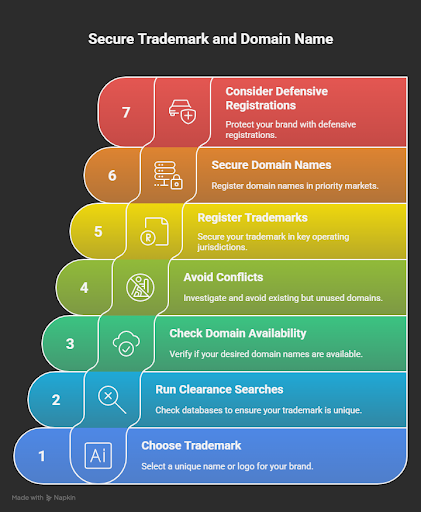
Also, with the new gTLD round and their expansion to take place in 2026, brand owners could consider registering domain names under a “.brand” gTLD, as certain activities such as phishing might be more difficult in a closed registration space.
Proactive Brand Rights Management
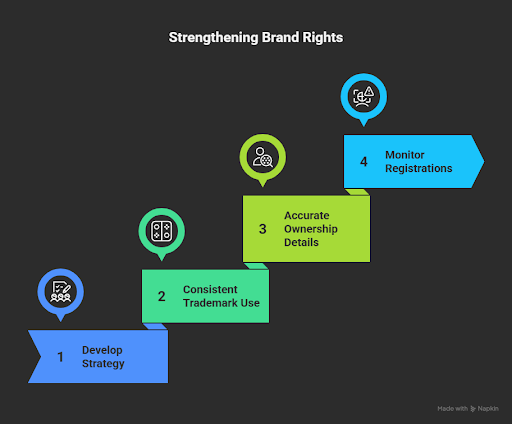
Registration of trademarks and domain names is a great start. However, an internal and proactive brand rights management strategy is one of the key elements when building a strong brand portfolio and here are some tips:
Create a brand protection strategy together with your Legal, Marketing, and IT departments: There should be clear internal rules for who can register trademarks and domain names, where they are registered, how the process looks like, which clearances are necessary and which strategy is to be followed.
Use your trademark: Consistent, visible use of your mark strengthens your legal position and in some jurisdictions it is a requirement for keeping your registration alive.
Keep your ownership information accurate: Use your legal entity’s name and a monitored email address for those registrations in order to build a coherent ownership across your trademark and domain name registrations. This may also be relevant in UDRP proceedings, where consolidation of disputes or filing a UDRP complaint against multiple domain name registrations might be the case. In addition, in line with the NIS-2 Directive (Directive (EU) 2022/2555), many domain name registries would need to verify registrants’ information.
Monitor third-party domain registrations: Given the global nature of trade and the Internet, brand infringement is not easily detected nowadays. Using online monitoring tools or a watch service to detect such infringement fast and targeted is a proactive protective measure that enables timely action and minimizes the potential damage to the brand.
From Registration to Enforcement
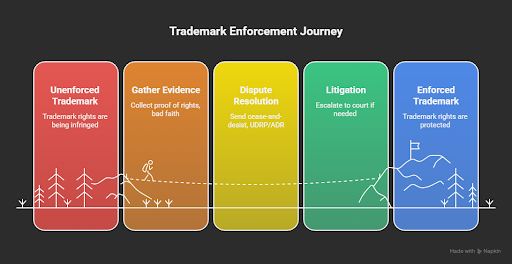
After registering your trademarks and domain names, if someone registers a domain name identical or confusingly similar to your trademark, then you might be able to successfully contest the domain name registration through a UDRP complaint.
As seen in a previous blog post regarding the roadmap of the UDRP procedure, a complainant must evaluate whether it’s a case of cybersquatting, which translates to an abusive registration of a domain name targeting a third-party trademark. It requires that a complainant proves a lack of legitimate use and bad faith registration and use of the domain name.
As a first step, the complainant should collect evidence of its prior rights and the domain owner’s behavior or factors that can be relevant, such as offers to sell, competitive website content, etc. We will give in subsequent posts more tips for brand owners and domain name registrants in preparing their case for each element of the Policy.
In jurisdictions where applicable, consider sending a cease-and-desist letter, followed by the initiation of the applicable dispute resolution procedure, whether this would be a UDRP or ADR procedure or court litigation.
Final Remarks
The protection of trademarks and domain names is not a one-off administrative task but an ongoing strategic process. The earlier brand owners integrate trademark and domain name considerations into their overall brand strategy, the stronger their position will be in preventing infringement and asserting their rights in any future dispute.
The UDRP is designed to be a fast and cost-effective process, but it places the evidentiary burden mainly on the complainant. The stronger and more organized brand protection measures are from the outset, the easier it will be to meet the three UDRP elements and demonstrate bad faith on the part of the respondent. The UDRP has been evolving through its case law for 25 years now and many principles have nuances that are complicated. Good preparation and seeking the advise of counsel is highly recommended and will make the difference between a swift transfer decision in your favor and a costly, drawn-out dispute, or even a lost case.
_________
About the author:

Stefanie Efstathiou is a dual-qualified lawyer (Greece and Germany) specializing in Intellectual Property, AI, Data Protection and Alternative Dispute Resolution, with particular expertise in domain name disputes. She serves as in-house counsel at DENIC eG, the registry for .de domain names, and acts as a panelist for several domain name dispute resolution providers. Her academic and professional work lies at the intersection of technology and ADR, where she is also pursuing a PhD at the Ludwig Maximilian University (LMU) in Munich on AI and Arbitration. In addition to her academic engagement, she also contributes as a member of an international task force developing guidelines on the use of AI in Arbitration, and regularly engages in conferences, professional networks, and publications in this field.
________
[1] Editors: Mihaela Maravela (Mihaela Maravela Law Office) and Mihaela Apostol (ArbTech)
[2] WIPO Overview 3.0, First UDRP Element, 1.1.3 (available at: https://www.wipo.int/amc/en/domains/search/overview3.0/#item11)
[3] WIPO Overview 3.0, First UDRP Element, 1.1.4 (available at: https://www.wipo.int/amc/en/domains/search/overview3.0/#item11)
